Whoever stays overnight on the Rigi today sleeps in the remnants of a system that was once significantly larger. According to the Luzerner Zeitung on Rigi tourism history, Rigi Kulm alone had 630 beds in three houses in 1875, and the Hotel Rigi-Kaltbad offered around 400 rooms around 1900, according to the Historisches Archiv Weggis. Today, overnight guests are distributed among a handful of establishments with 15 to 50 rooms each. The mountain hasn't gotten smaller, but its accommodation offerings have – and they are changing again.
Why the Palace Hotels Disappeared
All the grand hotels died in similar ways: first a collapse in demand, then a backlog of investments, then usually fire. The First World War ended the flow of travelers from Germany, France, Russia, and the USA that had sustained the Rigi. By 1936, the number of beds in the three Kulm hotels was reduced to a total of 300, as recorded in the Chronicle of the Rigi Kulm Hotel. The Hotel Rigi First burned down in 1948 – a case that became a media spectacle due to suspicion of arson, insurance fraud, and a clairvoyant consulted during the proceedings, as documented by the Blog of the Swiss National Museum.
The final curtain fell on the night of February 9, 1961. The Grandhotel Rigi-Kaltbad burned to the ground; around 180 guests and 60 employees were in the building. The fire brigades first had to fire up the steam locomotive to even get up the mountain – there was no cable car yet. A contemporary witness describes this in an SRF retrospective, which, like the Luzerner Zeitung, speaks of eleven fatalities. The Rigi Bahnen, however, mention thirteen deaths in their timeline. Ten months later, an employee of the hotel confessed to arson.
Rigi Kulm: Switzerland's Oldest Summit Hotel
At 1798 meters stands the building with the longest history. The Arth cloth cutter Joseph Martin Bürgi began construction in 1814, ran out of money twice, and was saved both times by an early form of crowdfunding: In 1815, the Zurich panorama artist Heinrich Keller collected 971 francs from donors for the construction, and in 1816, another 1400 francs from 338 patrons for the furnishings. On August 6, 1816, the guesthouse opened with six beds; the first guests were the builder and his workers.
The log cabin was followed in 1848 by a stone building with 130 beds, in 1856 by the Hotel Regina Montium with 200 beds, and in 1875 by the five-story Grand-Hotel Schreiber with 300 beds, three days after the Arth-Rigi-Bahn began operations. The building plot alone cost 200,000 francs, a day's stay 20 francs – a worker's weekly wage. The Südostschweiz notes that the Schreiber brothers at times owned five Rigi hotels.
There is no shortage of anecdotes. King Ludwig II of Bavaria was a guest several times with his entourage and brought a tea set that is still on display in a showcase in the dining room. More important for the hotel's history is an episode involving César Ritz, who was director here: When the central heating failed on a bitterly cold day and forty guests arrived for lunch, he changed the menu to warm dishes, moved the table to the smaller salon, and had forty bricks heated in the oven, which, wrapped in flannel, served as foot warmers. This performance caught the attention of the Lucerne hotelier Max Pfyffer – as can be read in the Wikipedia article on the Rigi Kulm Hotel, which is based on Ritz's 1938 biography.
Mark Twain remains the most famous. In "A Tramp Abroad," he describes how he and his companion Harris take several days instead of three hours to ascend, see the sunset at the top, oversleep the sunrise, and refuse the alphorn player an extra tip – they receive their sun ration according to the "European plan" and only pay for what they truly enjoyed. On their second attempt, after much puzzling, they observe the wrong direction of the sky. The text is available online in the original and in German in a retrospective by zentralplus.
The current building was constructed between 1950 and 1954 according to plans by the Zurich architect Max Kopp, after the Käppeli family bought the property in 1949. Usable materials from the demolition – parquet, sandstone stairs, mirrors, silverware – were reused. The hotel now has 32 renovated rooms and, according to its own statements, is open from the end of April to the beginning of December, meaning it is closed in winter.
Assessment: The Kulm Hotel has the most stable position of all Rigi businesses. It holds a monopoly on the summit, a functioning seminar niche, and a second pillar with its day restaurant. The main risk is the substance of a building from 1954 in an exposed location, not demand.
Rigi Kaltbad: Dahinden on the outside, Botta next door
At 1450 meters stands the largest accommodation facility on the mountain. After the 1961 fire, the specially founded "Neue Rigi Kaltbad-Hotel AG" built the Hostellerie Rigi Kaltbad between 1964 and 1966 according to plans by Justus Dahinden, a nephew of the Kaltbad hotelier and fire chief Alois Dahinden. A curiosity from that time has survived: The women's magazine "Annabelle" furnished five rooms, whose doors are still labeled accordingly, as noted in the hotel chronicle.
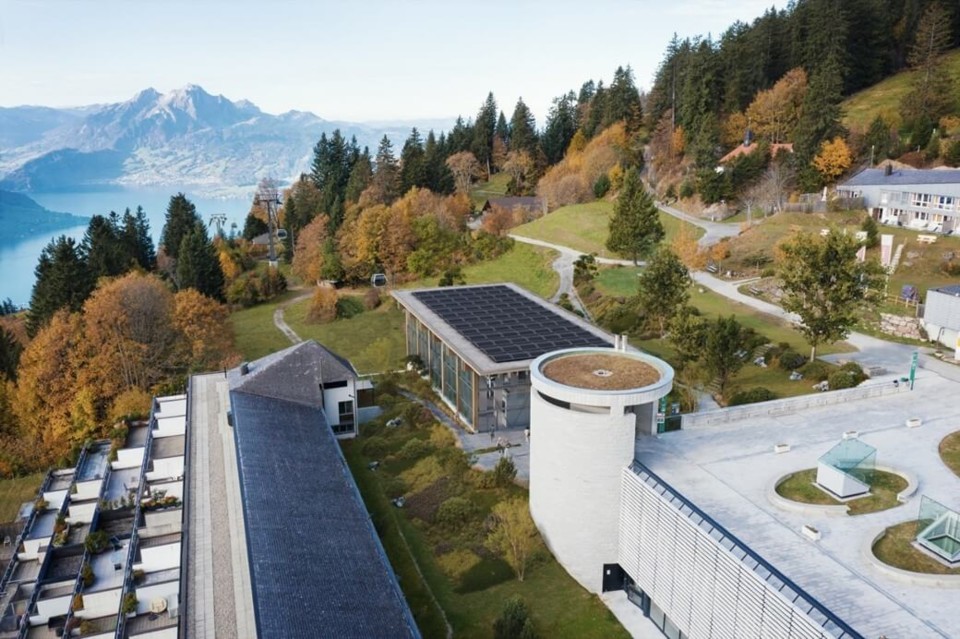
In 2012, the building was extensively renovated and reopened as Hotel Rigi Kaltbad, together with the new village square and the Mineralbad & Spa designed by Mario Botta. The bath continues a bathing tradition that began in 1540 with the healing of a Weggis resident in the cold spring; around 1600, according to the hotel chronicle, over a hundred bathers came up daily. Also documented: Queen Victoria rode from Küssnacht to Känzeli in 1868. The hotel now has around 50 rooms and six seminar rooms for up to 150 people, as stated by the specialist portal seminarlocations.ch.
Assessment: The combination of seminar infrastructure, bath, and direct train and cable car connections is unique on the Rigi and difficult to replicate. This makes the hotel less dependent on day-trip business than smaller establishments – but most affected if the cable car from Weggis is out of service for an extended period.
Staffelhöhe: the Kräuterhotel Edelweiss
Directly at the Staffelhöhe train station, at around 1550 meters, the Egger Vörös family runs a hotel in its fourth generation, which grew from a simple mountain guesthouse. Instead of demolition and new construction, the over hundred-year-old main building was renovated – the Zurich office Felder Architektur documents the decision, including its rational and emotional reasons.
The uniqueness is in the name. The gourmet restaurant Regina Montium works with several hundred herbs from its own garden; the Guide Michelin mentions around 400 different herbs and berries, the destination Rigi around 350. The hotel holds a Michelin star and 16 GaultMillau points. After ten years, head chef Benedikt Voss is leaving the establishment; sous chef Jannik Moser will take over from the summer season, as reported by htr hotelrevue.
Assessment: The Edelweiss is the most clearly positioned establishment on the mountain – the cuisine and garden support the hotel, not the other way around. This is precisely where the risk lies: a star restaurant is person-dependent, and the change in the kitchen leadership is the real test for the next two years.
The small houses in Kaltbad
The Hotel Bergsonne, built in 1933, with 18 rooms and a restaurant, is located a few minutes' walk above the village square and positions itself according to its own description as a retreat and workplace with a Luzernerstube, Chäs-Stübli, and roof terrace. It has been for sale since early 2026 for 2.5 million francs. The small Hotel Alpina advertises on its website with over a hundred years of hospitality and a double room with its own whirlpool on the roof terrace for 299 francs per night.
Rigi Klösterli and Rigi Staffel
At 1315 meters, in the oldest pilgrimage site on the mountain, stands the hotel "Zum Goldenen Hirschen". It dates back to the guesthouse "Schwert", which went to the hotelier family Fassbind in 1924, was renamed Hotel Rigi-Klösterli in 1979, and renamed again in 2011 – according to the Kulturspur of the municipality of Arth. Today it is supported by a circle of friends who, according to their own description, are connected by a school of life and spirit; the program includes courses on singing, movement, self-discovery, and healing, and the cuisine is predominantly vegetarian and organic. The information on its size varies: The Rigi destination mentions 32 rooms with 57 beds, a hotel portal 35 rooms.
Above the Rigi Staffel train station stands the Hotel Felchlin, built in 1875 – 14 rooms on the first floor, 18 on the second floor, and twelve attic rooms. It has been vacant for a long time and is looking for new owners for 4.4 million francs who can bring a viable usage concept and coordination with monument preservation, as reported by htr hotelrevue.
Assessment: Klösterli works because it doesn't operate as a classic hotel but as a course house with attached accommodation – this model is robust as long as the supporting organization exists. For the Felchlin, monument preservation is both: it protects the substance and makes every renovation more expensive. Without a buyer with long-term patience, further vacancy for years is plausible.
The South Side: Burggeist and Scheidegg
Above Gersau, at 1551 meters, lies the mountain guesthouse Rigi Burggeist with 25 sleeping places, reachable in ten minutes by cable car from Obergschwend. Its operating license expires at the end of 2026; the renovation will cost around 3.3 million francs according to the project website and is planned for 2027, financed among other things by an increase in share capital. Without the cable car, not only the guesthouse but also the year-round habitability of the hamlet would be questioned. A few kilometers further east, a family has been running the Berggasthaus Rigi-Scheidegg since 1991 – where the Rigi-Scheidegg-Bahn connected the noble hotels of Kaltbad, First, and Scheidegg until 1931.
What the next few years will bring
Demand is not the problem. The Rigi Bahnen recently counted 1.02 million guests with 39.9 million francs in net revenue, and the Rigi municipalities have the highest tourist intensity in the canton of Lucerne with 38.6 overnight stays per capita – figures from an analysis by htr hotelrevue. The problem is the structure: day guests fill restaurants, not beds.
Urs Eberhard, Chairman of the Board of Directors of RigiPlus AG, describes the upheaval in an interview as follows: individual businesses have created niches in which they are successful – seminars at Rigi Kaltbad and Rigi Kulm, self-discovery and alternative healing methods at Klösterli. However, this cannot stop the structural change. The most visible proof: the Hotel des Alpes, built in 1899, stood empty for about twenty years and is now being converted into 17 holiday apartments – cold beds instead of warm ones.
Above all hangs the access from Weggis. The over fifty-year-old funicular is to be replaced by a gondola lift with 22 cabins; the Rigi Bahnen argue with accessibility, seating for everyone, schedule-independent operation, and a capacity of 850 instead of 650 people per hour, with a later expansion being technically ruled out. The Federal Commission for Nature and Homeland Protection classifies the intervention in the BLN object as minor.
However, the Landscape Protection Association of Lake Lucerne, the Swiss Landscape Protection Foundation, and Pro Natura argue against this: instead of three, the new cable car would require 13 supports at eleven locations, five of which would extensively use protective forest, which would be weakened even after reforestation on a rockfall-prone slope – according to their objection in the planning approval process. In 2025, the Lucerne Cantonal Court sided with the associations regarding a procedural defect and overturned the zoning plan approval. In March 2026, the government council approved the cable car corridor a second time; the opening is planned for summer 2028, and the concession for the existing cable car expires in September 2027.
For the Kaltbad hotel industry, this is associated with a time window whose length no one can guarantee. Anyone buying a hotel on the Rigi in 2026 is betting that Weggis and Kaltbad will be reliably connected again from 2028. This explains part of the reluctance seen in vacant buildings and long sales processes – and it explains why businesses with their own niche are currently doing better than those waiting for general demand.