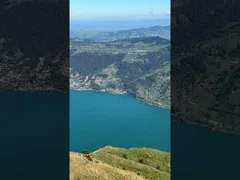
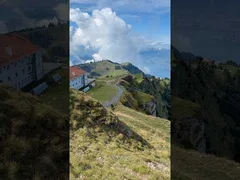
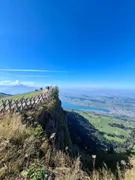
If you ask ten people in Luzern whether you should spend a summer day on the Rigi or on the Pilatus, you'll get a heated debate — but rarely a useful answer. Both mountains rise above Lake Lucerne, both are accessed by legendary cogwheel railways, and both offer postcard panoramas. As hiking destinations, however, they could hardly be more different — and the difference begins with the rock itself.
Two Mountains, Two Geologies
The Rigi (1798 m) is a massif of Nagelfluh — subalpine molasse conglomerate, essentially cemented river gravel — which weathers into rounded ridges, grassy terraces, and broad flanks. This geology is why the Rigi has around 120 km of marked summer hiking trails, most of them in the easy categories T1–T2, spread across an entire plateau of alpine meadows, viewpoints, and small car-free villages.
The Pilatus (2132 m at Tomlishorn) consists of folded Helvetic limestone. This weathers into exactly what you see from Luzern: rugged peaks, almost vertical north faces, and narrow ridge lines. The hiking terrain is correspondingly steeper, more exposed, and more concentrated — fewer kilometers of trail, but more drama per kilometer.
This single geological fact explains most of the practical differences below.

The Rigi massif from the air: rounded Nagelfluh ridges between three lakes. (Wikimedia Commons)
Hiking
The Rigi is a hiking network, not a single summit destination. The classic is the Panorama Trail from Rigi Kaltbad to Rigi Scheidegg, which follows the route of a railway line dismantled in 1931 — almost flat, suitable for strollers and wheelchairs on the official Route 848, with the optional Felsenweg (Rock Trail) as a section with deep views of Lake Lucerne and across to the Pilatus. Fit hikers can ascend from Vitznau or Weggis in about 2.5 hours, and because two cogwheel railways and two aerial cable cars access different flanks of the mountain, almost any hike can be turned into a round trip with an ascent or descent at both ends. The entire spectrum from ascent to stroll is covered.
The Pilatus offers a shorter menu with larger portions. From the summit complex, the ridge trail to Tomlishorn and the Blumenpfad (Flower Path) are spectacular hour-long hikes along the ridge; the Drachenweg (Dragon's Path) leads through rock galleries near the mountain station. The serious undertaking is the ascent from the valley, from Alpnachstad or via the Fräkmünt side — about 4 hours of continuous ascent compared to about 2.5 on the Rigi, with correspondingly more exposure and elevation gain. Halfway up, Fräkmüntegg offers Switzerland's longest summer toboggan run and a rope park — making the Pilatus the stronger choice for families looking for action rather than hiking.
The Pilatus railway overcomes gradients of up to 48% — the steepest cogwheel railway in the world.
The Way Up (and the Railway Superlatives)
Both railways are historical superlatives — half the reason tourists come at all.
- Rigi: The Vitznau–Rigi line, opened in 1871, was Europe's first mountain railway; a second cogwheel line leads up from Arth-Goldau, plus aerial cable cars from Weggis and Kräbel. Everything operates year-round.
- Pilatus: The line from Alpnachstad, opened in 1889, is still the steepest cogwheel railway in the world with 48%. It is seasonal — in 2026, it operates from May 11 to November 29, and seat reservations are strongly recommended on fair-weather weekends. The Kriens side (panoramic gondola lift plus "Dragon Ride" aerial cable car) is in operation year-round.
The travel experience also differs: The Rigi is a mountain you circumnavigate — boat, two railways, cable cars, getting on and off between the hamlets. The Pilatus is a mountain you traverse, ideally as the famous Golden Round Trip: boat from Luzern, cogwheel railway up, cable car down to Kriens, bus back.
Prices and Passes — Where the Difference is Real
The regular prices are close on paper, but the pass coverage is not — and for anyone with a Swiss Travel Pass, that's exactly what decides the question:
| Rigi | Pilatus | |
|---|---|---|
| Day ticket / Return (2026, adults) | Day ticket CHF 78, all railways & cable cars | Return approx. CHF 84 from Alpnachstad or Kriens; Golden Round Trip CHF 119.80 from Luzern |
| Swiss Travel Pass | Free | 50% discount |
| GA / Half-Fare Card | Free / 50% | 50% |
| Tell Pass | Free | Free |
| Children | Up to 15 free when accompanied by an adult | 6–15 half price |
| From Zurich HB (public transport) | approx. 1 h 29 min to Rigi Kulm, hourly direct connection via Arth-Goldau | approx. 2–2.5 h to Pilatus Kulm: train to Luzern, then Zentralbahn to Alpnachstad + cogwheel railway, or bus to Kriens + gondola/aerial cable car (two changes in both variants) |
The full acceptance of GA, Half-Fare Card, and Swiss Travel Pass is also why around 70% of Rigi guests travel by public transport — a figure that the company states is a top value among Swiss mountain railways.
Visitor Flows and Guest Numbers
Neither mountain is a secret tip. Rigi Bahnen reported its fourth consecutive record year in 2025 with 1.02 million first entries, 70% of which were Swiss guests; the USA is now the most important foreign market. Pilatus-Bahnen counted 840,870 first entries in 2025 — also a record — of which 604,562 went to the summit; the rest stayed at the leisure facilities halfway up. For context: in 2024, there were 796,594 guests on the Pilatus, and in 2023, 760,956. Both mountains are therefore in the high six- to seven-figure range, with the Rigi about 20% ahead.
The guest mix differs more than the totals. With a 70% domestic share, the Rigi is somewhat of a locals' mountain that tourists also visit; the Pilatus-Bahnen business report, on the other hand, emphasizes the deliberately cultivated "balanced guest mix" with visitors from all over the world and strong demand from North America — a bucket-list destination that locals also use.
The distribution of visitor flows also differs. On the Pilatus, almost everything funnels through a single summit complex, which is why the terraces and the Esel viewpoint fill up by late morning. On the Rigi, the million visitors are spread across an entire massif: Kulm gets crowded, but fifteen minutes along the Panorama Trail, the crowd thins out significantly, and side ridges like Rigi Scheidegg or the Hochflue remain quiet even in August.
Time Budget and Weather Strategy
The Pilatus works as a half-day trip — from Kriens to the summit takes about 40 minutes, and even the complete Golden Round Trip fits into 5–6 hours. The Rigi rewards a full day: boat to Vitznau, train up, a proper hike, perhaps the mineral bath in Rigi Kaltbad, and down again on a different route.
The picture shifts, however, with the starting point. From Luzern, the Pilatus is the quicker excursion. From Zurich, it's the opposite: Since the timetable change in 2025, the journey from Zurich HB to Rigi Kulm takes 89 minutes with an hourly direct connection via Arth-Goldau — a single change on the same platform. Pilatus Kulm can be reached from Zurich HB in about 2 to 2.5 hours, depending on connections: train to Luzern (approx. 45 min), then either Zentralbahn to Alpnachstad (approx. 20 min) plus 30 minutes cogwheel railway, or bus 1 to Kriens plus approx. 40 minutes gondola and aerial cable car ride — two changes in both variants, with tighter transfer times.
For both mountains, the universal local advice applies: Only decide on the morning itself. Both operations have live webcams, and a summit in the fog remains a summit in the fog, no matter how impressive the train ride was. The lower elevation of the Rigi means it is more often below the cloud cover; the Pilatus, over 300 meters higher, catches weather first, but also rises above inversion fog that can envelop Rigi Kulm.
Which Mountain is Suitable for Whom?
Families with small children. The Rigi wins with the youngest, the Pilatus with adventurous school children. On the Rigi, children up to 15 travel free when accompanied by an adult, the official Panorama Trail is stroller-friendly on a wide, almost flat gravel path, and themed trails with playgrounds, fire pits, and family-friendly restaurants line the route — a toddler can be pushed, carried, or allowed to walk almost anywhere. The Pilatus counters halfway up: Fräkmüntegg offers Switzerland's longest summer toboggan run, the Pilu rope park, a treetop walk, and the Dragonglider, plus the Dragon World at the summit — great for children aged about six and up. However, the summit trails themselves have stairs and drop-offs, and children under 16 pay half price instead of riding for free.
Seniors and people with reduced mobility. Both summits are accessible without a single step of ascent, but the Rigi is the friendlier mountain at the top: The official Route 848 of the Panorama Trail is wheelchair-accessible, the terrain offers benches and flat sections everywhere, numerous intermediate stations allow a hike to be shortened along the way, and the Kaltbad mineral bath is a worthwhile destination without any effort. On the Pilatus, the terraces and the panoramic gallery on Kulm are paved and step-free — the company created new disabled-friendly accesses in 2025 — but the rewarding trails (the Esel stairs, the Tomlishorn trail) involve steps and exposure that not everyone finds comfortable.
International tourists. For those flying in for a week and able to choose only one mountain, the Pilatus offers a more concentrated spectacle: the steepest railway in the world, dragon mythology, a dramatically rugged summit, and the Golden Round Trip, which packages boat, cogwheel railway, cable car, and bus into a compact bucket-list day. Visitor statistics support this — the Pilatus cultivates a global guest mix, while 70% of Rigi guests come from Switzerland. The Rigi's international argument is different: This is where mountain tourism was practically invented — Europe's first mountain railway, Victorian sunrise pilgrimages, Mark Twain's legendary botched Rigi ascent in A Tramp Abroad — and the mountain is included free with the Swiss Travel Pass, which most international guests already have.
Restaurants and Mountain Cuisine
The Rigi has by far more variety, because its gastronomy has grown organically across an entire massif: independent mountain guesthouses and restaurants on Kulm, Staffel, Staffelhöhe, Kaltbad, First, Klösterli, Scheidegg, and Burggeist, alpine dairies with their own cheese along the trails, and a spectrum ranging from Spätzli and Rösti taverns to nine-course fine dining. You can plan an entire hike around where you want to eat.
The gastronomy on the Pilatus is concentrated and from a single source — almost everything is operated by Pilatus-Bahnen AG itself — but polished: two historic hotels on the summit with à la carte and self-service restaurants, the panoramic terrace, plus formats like fondue gondolas, astronomy evenings, and Sunday brunch that primarily target regional guests. Less choice, shorter distances between them — and the only place in this comparison where you can dine at 2100 m and sleep above the clouds without walking a single meter.
Do You Need Proper Hiking Boots?
For the standard tourist routes: no. The Rigi Panorama Trail and most T1 trails of the massif are wide gravel — clean sneakers or trail runners are sufficient, and the strollers on the path prove it. On the Pilatus, the summit trails (Drachenweg, Blumenpfad, Esel) are developed paths for which sturdy everyday shoes are sufficient; the ridge trail to Tomlishorn, however, deserves proper tread and dry conditions.
Real hiking footwear becomes useful the moment you leave the main trails: on the ascents from the valley (around 2.5 hours to the Rigi, 4 hours to the Pilatus), on the steeper Pilatus flanks, or on any trail after rain — Nagelfluh gravel drains well, while limestone becomes slippery. Ankle-high shoes with a grippy sole cover everything described in this article; heavy alpine boots are overkill on both mountains.
Conclusion
Choose the Rigi if hiking is the point: more trails, gentler slopes, round trip options, villages and restaurants along the way — and free with the Swiss Travel Pass. It is also the better mountain for toddlers, strollers, wheelchairs, seniors who truly want to hike, and anyone starting in Zurich. Choose the Pilatus if the summit is the point: a more alpine, dizzying mountain peak, the steepest railway in the world, stronger adventure offerings for school children, and a more compact half-day excursion from Luzern that often remains a highlight for international guests. And if you're in the region for more than two days — do both. They face each other across the lake, and each is the best viewpoint for the other.
Sources
- https://www.rigi.ch/de/informieren/preise
- https://shop.rigi.ch/en/pages/tickets-hikingtickets
- https://www.myswissalps.com/activity/rigi/
- https://www.myswissalps.com/activity/pilatus/
- https://pilatus.ch/en/railway-cableways/prices
- https://pilatus.ch/en/railway-cableways/timetable
- https://swissfamilyfun.com/rigi-panoramaweg/
- https://swissfamilyfun.com/pilatus-golden-round-trip/
- https://holidaystoswitzerland.com/how-to-visit-mount-pilatus/
- https://loop-tours.com/rigi-or-pilatus/
- https://www.swissactivities.com/en-ch/rigi/rigi-day-pass/
- https://www.schweizeraktien.net/blog/2026/04/28/rigi-bahnen-viertes-rekordjahr-in-folge-dank-jubilaeum-und-gutem-wetter-72876/
- https://cdn.pilatus.ch/content-media/documents/Unternehmen/Geschaeftsbericht-2025.pdf
- https://www.htr.ch/story/tourismus/rigi-bahnen-zufrieden-mit-vergangenem-geschaeftsjahr-40077
- https://hikeanddine.com/hiking-rigi/