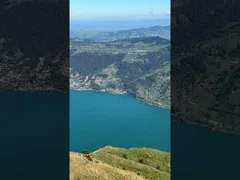
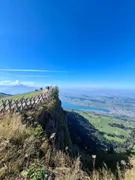
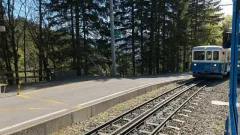
You have a day off, good weather is forecast, and now you're faced with the classic Central Swiss luxury question: Rigi or Melchsee-Frutt? Both are great – but they are great in very different ways. I'll take you by the hand here, as a friend who knows both mountains well would.
The short version first: On the Rigi, the gastronomic selection is significantly larger and more spatially distributed. Nevertheless, current opening days should be checked, especially outside the main season. Melchsee-Frutt is the quieter, more alpine high plateau with mountain lakes, where children search for marmots and adults can finally take a deep breath. And now in detail.
The two candidates in profile
| Rigi | Melchsee-Frutt | |
|---|---|---|
| Altitude | 1,798 m (Rigi Kulm) | 1,920 m (high plateau), peaks up to ~2,480 m |
| Character | "Queen of the Mountains", panoramic mountain between Lake Lucerne, Lake Zug, and Lake Lauerz | Largely car-free high plateau with Melchsee, Tannensee, and Blauseeli; in summer, restricted motorized access is permitted. |
| Access | Two cogwheel railways (Vitznau & Arth-Goldau), aerial cableways | Gondola from Stöckalp, at the top Frutt train and Bonistock cable car |
| Hiking trails | Around 120 km, many flat and suitable for strollers | Around 50 km, from lakeside paths to alpine summit tours |
| Visitors per year | Over 1 million | Significantly fewer (no official visitor numbers published; a fraction of the Rigi) |
| Fame | World-renowned for over 150 years | Known primarily to Swiss families |
Regarding visitor numbers: Rigi Bahnen reported a record year with 1.02 million first entries for 2025 – the fourth record year in a row. For Melchsee-Frutt, no directly comparable annual visitor number is published. Therefore, visitor crowds cannot be reliably derived from company revenues. As a practical rule of thumb: Rigi Kulm can be very busy on sunny weekends. Melchsee-Frutt often seems quieter, but is also well-frequented during school holidays and on good weather days. Those seeking as much peace as possible should choose a weekday for both destinations and start early.
Families with small children: Melchsee-Frutt has the advantage
Both mountains are family-friendly, but Melchsee-Frutt offers a particularly large number of activities that can be easily combined with small children. The plateau is largely car-free, flat, and easy to navigate. However, it is not completely car-free in summer: the mountain road is open for light motor vehicles during fixed time slots. Parents should therefore still pay attention to traffic, especially around the village and access roads. The star is the Fruttli Trail, a marmot adventure trail around the Melchsee with play and climbing stations and a stamp booklet. There are also playgrounds, fire pits directly by the lake, and the Fruttli train to Tannalp (chargeable, but children love it). Fishing is possible at Melchsee, Tannensee, and Blauseeli. A paid fishing license is required for this; special age and supervision rules apply to children. If you plan to do this, you should check prices, season, and regulations beforehand on the official fishing website.
The gondola from Stöckalp is barrier-free and easily accommodates strollers.
The Rigi is also good for families: the panoramic path from Kaltbad towards Scheidegg is suitable for strollers because it runs almost without incline on the old railway line, and the cogwheel train ride is an experience in itself for children. But: more activity, more railway tracks, more "please give me your hand". Nevertheless, the Rigi has a strong ace up its sleeve: ‹Rigiland› in Rigi Kaltbad. Here awaits a huge adventure playground with a rope park, mini-golf course, and barbecue areas – all directly at the station and perfectly accessible with a stroller via flat paths.
Conclusion: For play trails, fire pits, and a clear day by the lake, Melchsee-Frutt is ahead. The Rigi, however, offers an easier round trip and can be significantly cheaper for families thanks to children traveling free. The age of the children alone is therefore not a sufficient decision criterion.
International tourists: A clear case for the Rigi
For a first visit to Lucerne and Central Switzerland, the Rigi is usually the more complete overall package: boat, historic railway, and summit panorama can be easily combined. The Rigi has been a fixture of international Swiss tourism since Mark Twain's time. The journey itself is part of the attraction: by boat – depending on the route and operating day, a historic steamboat – from Lucerne to Vitznau and then with Europe's first mountain railway, opened in 1871, to Rigi Kulm. With very good visibility, the panorama extends over up to 13 lakes. This complete package of lake, boat, historic railway, and 360-degree panorama over 13 lakes is unique. Since spring 2026, there will also be the historic locomotive 7 from 1873 as a free exhibition on Rigi Kulm. GA and various tourist passes are valid on the Rigi Bahnen, which makes things even easier for international guests.
What many don't know: Tourism on the Rigi began long before the railway. As early as the 16th century, people made pilgrimages to Rigi Kaltbad to the ‹Three Sisters' Fountain›. According to legend, a bath in this ice-cold spring promised healing from various ailments. It is precisely from this legendary spring that today's Botta mineral bath is still fed – though today it is pleasantly warmed to 35 degrees.
Melchsee-Frutt is more of an insider tip for international guests – if you've completed the tourist must-do program and want to see Switzerland as the Swiss themselves enjoy it.
Elderly people: Rigi has the advantage
For people who are not so good on their feet anymore, the Rigi is hard to beat: The train goes all the way to the summit, and the panorama is available without a single meter of walking. Already around the station, a wide view opens up; a short ascent leads to the highest viewpoint. Those who want to walk as little as possible will also find several officially designated barrier-free paths on the Rigi. If you like, you can stroll on the flat panoramic path, stop at one of the many mountain restaurants, or treat yourself to the mineral bath in Rigi Kaltbad. The panoramic path from Rigi Scheidegg to Rigi Wölfertschen is even wheelchair accessible.
Frutt is also suitable for seniors – the plateau is flat, the Frutt train helps with tired legs, and the gondola is barrier-free. But the really grand views (Bonistock, Hochstollen) require more effort there, and the network of paths at the top is stony in places. (Tours to the Hochstollen vary considerably in difficulty and character. Therefore, a specific route should be chosen before departure, and its current classification, weather conditions, and path condition should be checked.)
Conclusion: Rigi, quite clearly. Maximum view with minimal effort has been its business model since 1871.
Restaurants: Rigi for quantity, Frutt for surprise
The Rigi clearly wins in terms of sheer selection. Distributed across Kulm, Staffel, Kaltbad, First, Scheidegg, Klösterli, Unterstetten, and Seebodenalp, you'll find dozens of options – from self-service restaurants to rustic mountain inns and the à la carte restaurant in the Rigi Kulm Hotel with Cordon Bleu with Rigi alpine cheese and entrecôte from Rigi organic beef. At Rigi Staffel, you can sit in the Restaurant Lok 7 with a large terrace. You can easily "hike" from terrace to terrace on the Rigi all day long.
Melchsee-Frutt has fewer addresses, but a surprising range: from hearty mountain cuisine to gourmet creations. The Frutt Lodge & Spa brings upscale cuisine to 1,920 meters, and at the other end of the scale, the Berggasthaus Tannalp awaits with a sun terrace and views of the Central Swiss and Bernese Alps, where you can stop after a hike around the Tannensee.
Conclusion: Larger and more flexible selection on the Rigi. But Frutt can also offer a unique, special dining experience (rustic alpine hut or lodge gourmet).
Hiking boots or sneakers?
On wide, easy paths, sturdy sneakers with good grip are often sufficient in dry conditions. For white-red-white marked mountain hiking trails, sturdy hiking boots are recommended; white-blue-white alpine routes require experience and appropriate equipment. After rain, with residual snow, or in uncertain weather conditions, the choice of footwear should be more defensive.
Rigi: Panoramic path, Kulm circular path, walks between stations – all wide gravel paths. In dry conditions, sneakers are sufficient there. Even if you plan to do the Felsenweg with its passages carved into the rock (the Felsenweg is always closed in winter and occasionally in summer due to rockfall – but there are other paths from there), sneakers are fine. Only if you plan ascents and descents like towards Seebodenalp are hiking boots the better choice.
Melchsee-Frutt: The lake circular paths (Melchsee, Tannensee, Fruttli-Weg) are good in sneakers. However, as soon as you want to go towards Bonistock, Hochstollen or via Abgschütz to Älggialp, you are in real mountain trail terrain – there, depending on the chosen route, hiking boots with profiles belong on your feet, and sometimes surefootedness and alpine experience are required.
Rule of thumb: Rigi = sneaker mountain with hiking boot option. Frutt = sneaker plateau with hiking boot requirement as soon as you go high up.
Instagram Appeal: Where are the best photos?
Rigi – the classics:
- Sunrise on Rigi Kulm above the sea of fog – probably the most famous Swiss autumn shot ever. It's worth staying overnight at the Rigi Kulm Hotel or taking the first train.
- The red cogwheel train against the Lake Lucerne backdrop – best on the section above Vitznau or at the crossing point.
- Känzeli viewpoint above Rigi Kaltbad: the classic stop with a gigantic panorama over the lake.
- Mineralbad & Spa Rigi Kaltbad (Mario Botta architecture) – outdoor pool with mountain views.
Melchsee-Frutt – the underrated:
- Melchsee in calm morning conditions – the reflection of the chapel, village, and mountain range in the lake is the signature image of Frutt.
- Blausee – small, intensely turquoise, an insider tip off the main plateau.
- Bonistock observation platform – view over the entire lake district to the Wetterhorn group.
- The Frutt train on the open track to Tannalp – a charmingly playful motif that hardly anyone has on their radar.
Caution - for experienced alpine hikers only: The Europaleiter consists of two approximately 30-meter-long, almost vertical ladder sections on white-blue-white marked terrain. A climbing harness and safety equipment are mandatory for the descent. A head for heights, surefootedness, and experience with alpine routes are required; a mountain-savvy companion is recommended. The Europaleiter is not a family outing and not a spontaneous detour with ordinary hiking equipment.
If you're going for maximum reach: Rigi (sunrise + sea of fog beats almost everything). If you want pictures that are not already in a thousand feeds: Frutt.
The weather can turn the decision around: The Rigi's strength is its distant panorama – in poor visibility, a large part of this advantage is lost. Melchsee-Frutt offers more close-up motifs with lakes and plateaus, but it is higher and can therefore be cooler, windier, or affected by residual snow for longer. Before departure, it is therefore worth checking both webcams and not just the general weather forecast for Lucerne.
Arrival by public transport: Numbers for planning
| Route | Rigi (Kulm) | Melchsee-Frutt |
|---|---|---|
| From Zurich HB | approx. 1 h 30 – since the new timetable only 89 minutes to Rigi Kulm via Arth-Goldau | approx. 2 h 15 (train to Lucerne, change to Sarnen, Postbus, gondola) |
| From Lucerne | approx. 1 h 15 via Arth-Goldau + cogwheel railway; or the pleasure program: approx. 1 h boat to Vitznau + 30 min. cogwheel railway | approx. 1 h 30: Zentralbahn to Sarnen, Postbus line 343 to Stöckalp, then approx. 15 minutes gondola to the plateau |
| Frequency | Frequent; cogwheel railways hourly, more often in high season | Attention: the Postbus from Sarnen only runs hourly in summer – check timetable beforehand |
An important price difference: GA, SBB day tickets, and Swiss Travel Pass are valid on the Rigi Bahnen without surcharge. Children up to and including 15 years travel free when accompanied by at least one adult. Melchsee-Frutt, on the other hand, is not fully covered by the GA. In 2026, a return gondola ticket for adults costs CHF 39, with GA or Half-Fare Card CHF 19.50, and for children aged 6 to 15.99 years CHF 10. With a Junior Card, the gondola ride itself is free; for the day ticket including Bonistockbahn and Frutt train, CHF 5 is charged even with a Junior Card. (Summer fares Frutt)
Important for day planning: The Stöckalp–Melchsee-Frutt gondola can take a lunch break from 12:20 to 13:20 during low frequency. The last regular descent in 2026 is at 17:20; on Saturdays, Sundays, and public holidays, there is an additional descent at 17:50. Bonistockbahn and Frutt train have their own, sometimes earlier, last departures. Therefore, check operating status and connections again on the day of the excursion.
On the Rigi, the last family-friendly cable car ride to Weggis is at 19:10 (after that, only one at 23:20).
Is a day trip enough? And can both be done in one day?
A day trip is easily enough for both. The Rigi is the perfect half-day to full-day excursion: go up, panoramic path, lunch, Kulm, down – and you have a picture-perfect day. On Frutt, you can also wonderfully fill a day with a lake circular path, Fruttli path, lunch at Tannalp, and gondola back. If you want to do the great four-lake hike towards Engelberg, you should start early – that's a full hiking day.
Both in one day? Technically feasible, but completely stressful. You would spend three hours just transferring across Central Switzerland and would have no time to breathe on either mountain. My advice: Decide – and save the other mountain for future anticipation.
Two lesser-known experiences
Rigi: The relics of the vanished Scheidegg railway. Between Rigi First and Rigi Scheidegg, you hike on the route of a cogwheel railway that operated from 1875 to 1931 and whose tracks were removed in 1943. What hardly anyone knows – not even many locals: Along the way, there are still the old railway bridge Unterstetten, a tunnel, a water filling station for steam locomotives, and even a disused passenger car that now serves as a holiday home. You practically stroll through an open-air museum of railway history here – flat, free, and far from the Kulm crowds.
Melchsee-Frutt: The Europaleiter to the center of Switzerland. The Älggialp, the geographical center of Switzerland, lies just behind the ridge – and the most spectacular connection there is the Europaleiter: two vertical ladder passages of 30 meters in the rock, only doable with a climbing harness, safety equipment, and a head for heights (official alpine hike difficulty T5). Even many people from Obwalden only know this by hearsay. If you prefer something more relaxed: The normal mountain hike via the Abgschütz to the Älggialp is an experience even without a ladder – including the punchline that the real center is not at the monument, but about 500 meters away in inaccessible steep terrain. Nevertheless, the picnic spot at the monument is an excellent place to sit.
Strengths and weaknesses at a glance
| Rigi | Melchsee-Frutt | |
|---|---|---|
| Strengths | Train to the summit, huge restaurant selection, world-class panorama, ideal for seniors and public transport purists, historic railway flair, fastest journey from Zurich | Car-free and child-friendly, mountain lakes to touch, significantly quieter, real alpine terrain for hikers, fair prices, insider tip factor |
| Weaknesses | Over 1 million guests per year – crowded on good weather weekends; little "wild" terrain | Longer and more complicated journey (Postbus only hourly), smaller gastronomic selection, for the really big panoramic wow, hiking effort is needed |
| Perfect for… | International guests, seniors, pleasure hikers, railway fans, sunrise seekers | Families with small children, those seeking peace, sporty hikers, mountain lake romantics |
My conclusion as a local
If your grandparents, your visitors from overseas, or your photo ambitions are traveling with you: Rigi. It delivers the maximum Swiss experience per invested muscle power, and the combination of boat + cogwheel railway + summit panorama is simply incomparably staged.
If you have small children, tired nerves, or a desire for real mountain trails: Melchsee-Frutt. There, the plateau is almost all yours on a beautiful summer morning (early in the morning and during the week, the plateau often seems significantly quieter than the main areas around Rigi Kulm. On sunny weekends and during school holidays, however, you should not expect solitude on Melchsee-Frutt either), and the children are happy for hours with the marmot trail and the lakeside. Sporty mountain hikers will find more challenging tours around Bonistock, Abgschütz, and Hochstollen. Difficulty, trail marking, and current conditions must be checked separately for each specific route.
And the best part: The two are so close to each other that the question "Rigi or Frutt?" is actually never an either-or. But only a "Who first?".
All information as of July 2026 – it is best to check the timetables and operating hours of the railways online shortly before your excursion.
Further links
Rigi
- Official timetables of the Rigi Bahnen
- GA, day tickets, child and half-fare regulations
- Barrier-free hikes
- Rigi Kulm and altitude
- Facts about railways, hiking trails and lakes
- Boat services and steamboat timetable
Melchsee-Frutt