- Current Status: The cable car can operate until the end of September 2027, but construction can only begin later. The new cable car can only start operating sometime after May/June 2028.
- Permit for current cable car: until end of September 2027
- Start of construction for new gondola lift: after autumn 2027 (delayed)
- Originally planned commissioning: May/June 2028 (delayed)
Since mid-August 2026, a construction permit from the federal government has been issued for the new gondola lift between Weggis and Rigi Kaltbad in the first instance, but construction still cannot begin. The reason lies in a zoning plan amendment by the municipality of Weggis, against which an appeal is still pending before the Lucerne Cantonal Court. Rigi Bahnen therefore announced on August 20 that a start of construction in autumn 2027 is no longer realistic and is examining a further extension of the operating permit for the existing aerial tramway with the Federal Office of Transport.
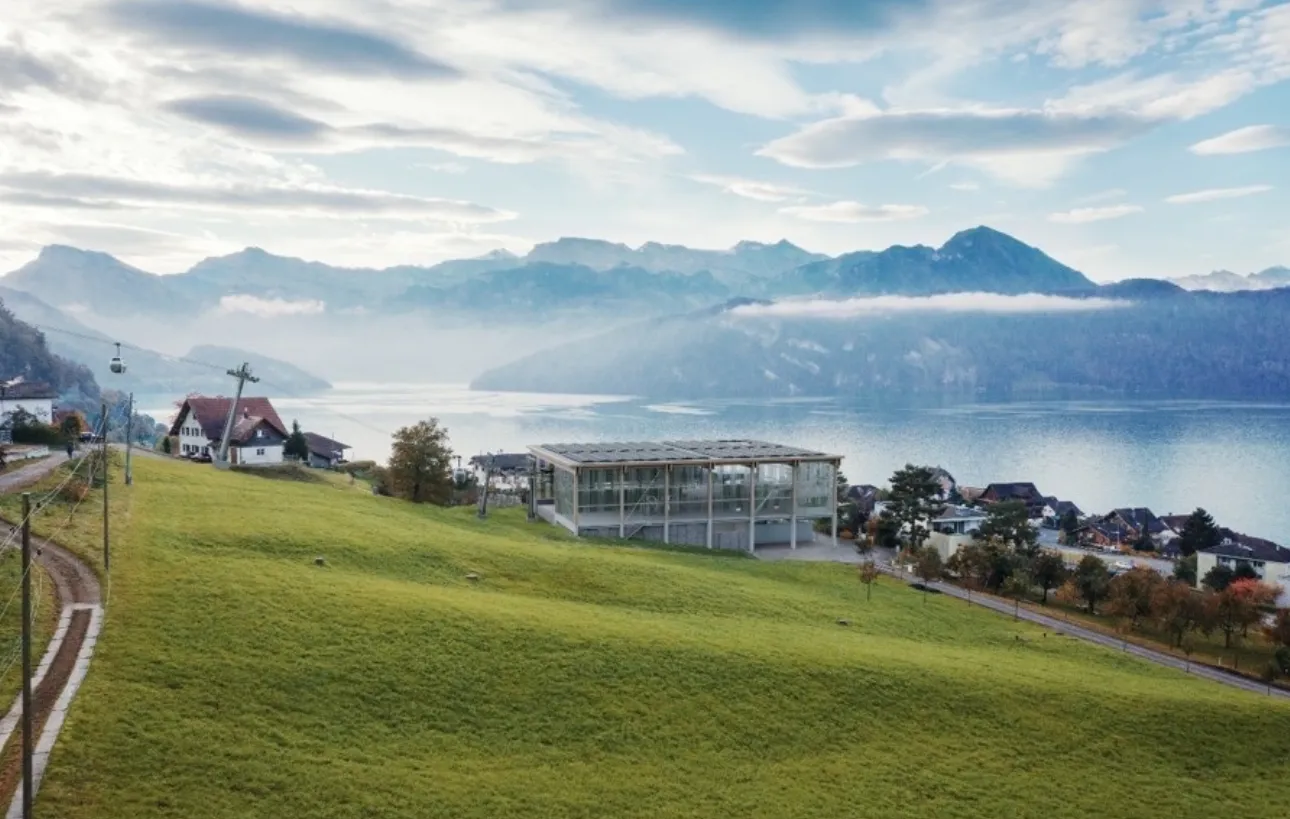
Photo from Source
Time is Running Out
In Switzerland, a cable car for passenger transport requires two things from the federal government: a planning approval to build it, and an operating permit to operate it. Both are time-limited. If the operating permit expires and no new system is ready, the railway stands still.
Rigi Bahnen states on its project page for the renewal of the Weggis cable car that the concession and operating permit have been extended for the last time by five years until September 2027 by the Federal Office of Transport, subject to conditions.
Planning has been going on for a long time: the minutes of the 32nd ordinary general meeting in 2024 mention planning work for over ten years, and that the concession, which has already been extended twice, will definitely expire at the end of September 2027.
From the Rejected Funicular to the 1968 Railway
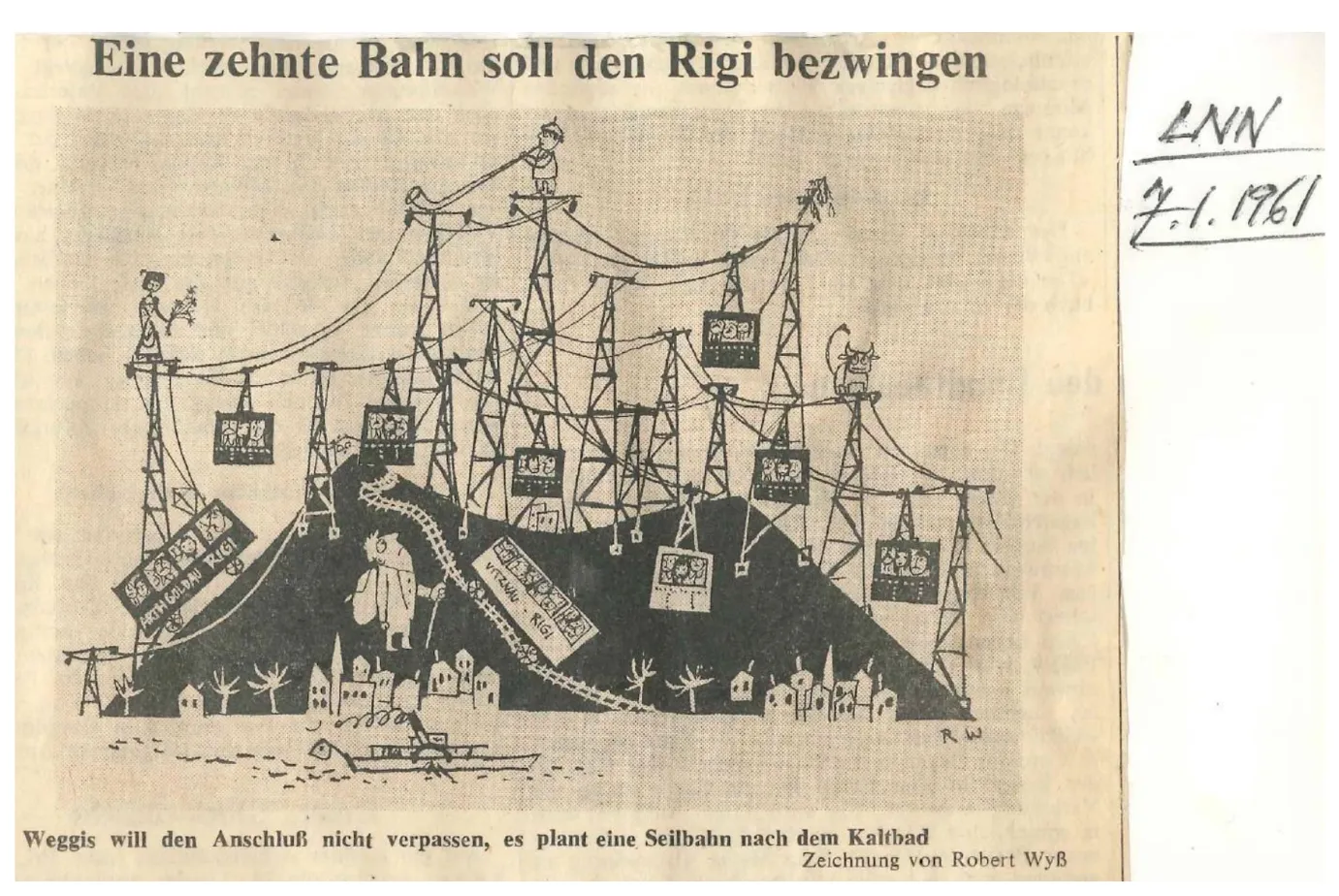
Photo from Archiv Weggis
Many archive images of Rigi Kaltbad and the history of the cable car can be found in the PDF from Archiv-Weggis: The History of the Weggis – Rigi Kaltbad Cable Car (Original was here, but seems to load poorly)
The history of transport between Weggis and the Rigi begins with a defeat. In 1888, the mountain railway pioneers Franz Josef Bucher and Josef Durrer submitted a concession application for a funicular from Weggis to the Känzeli viewpoint. The Federal Council rejected it - the message of December 3, 1888 in the Federal Gazette states: With the Vitznau-Rigi-Bahn and the Arth-Rigi-Bahn, enough mountain railways already led up the mountain, and the concession of the Vitznau-Rigi-Bahn excluded any further mountain railway on the Rigi for thirty years.
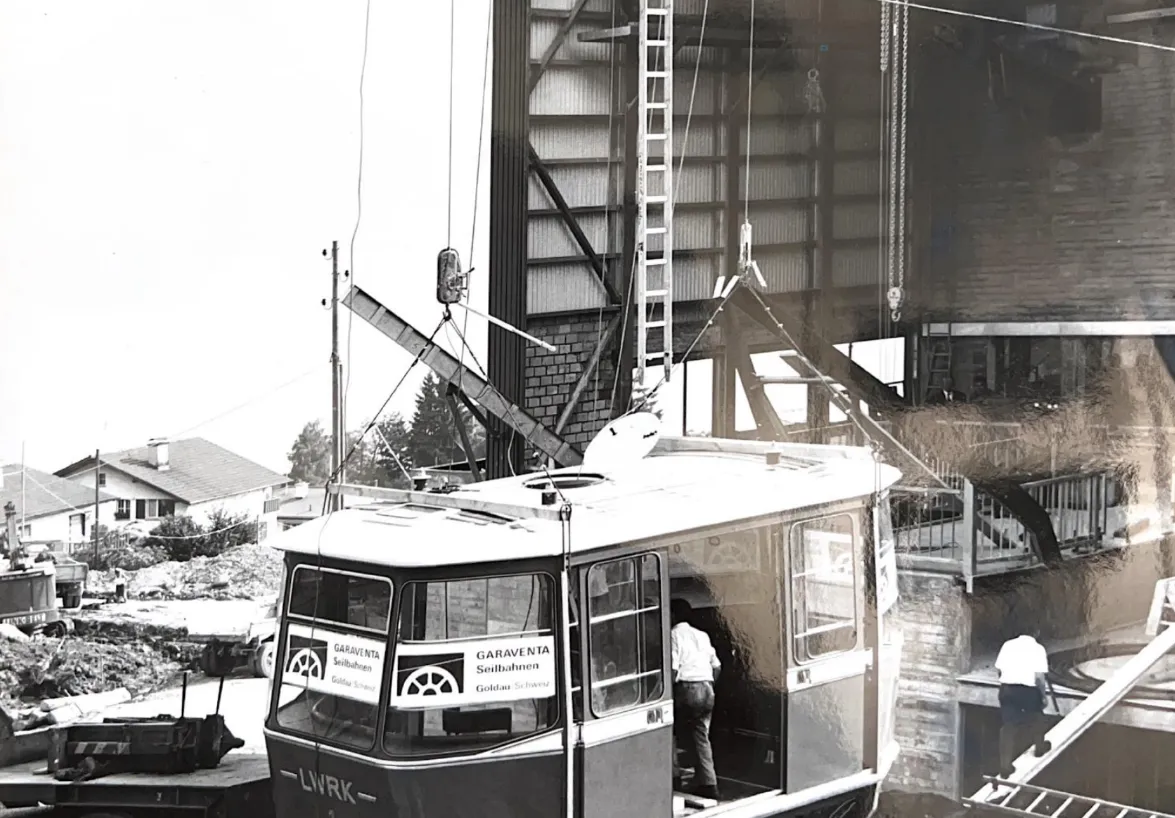
Photo from Archiv-Weggis
The second attempt in 1964 was successful. The German-language Wikipedia article on the Weggis–Rigi Kaltbad aerial tramway notes that the initiative committee reached an agreement with the Vitznau-Rigi-Bahn and transferred its construction and operation to them; the concession for the aerial tramway was granted on September 24, 1964. The English-language description of the Rigi Railways adds that the route from Weggis was deliberately chosen not to compete directly with the cogwheel railway, and that the construction period was only eleven months.
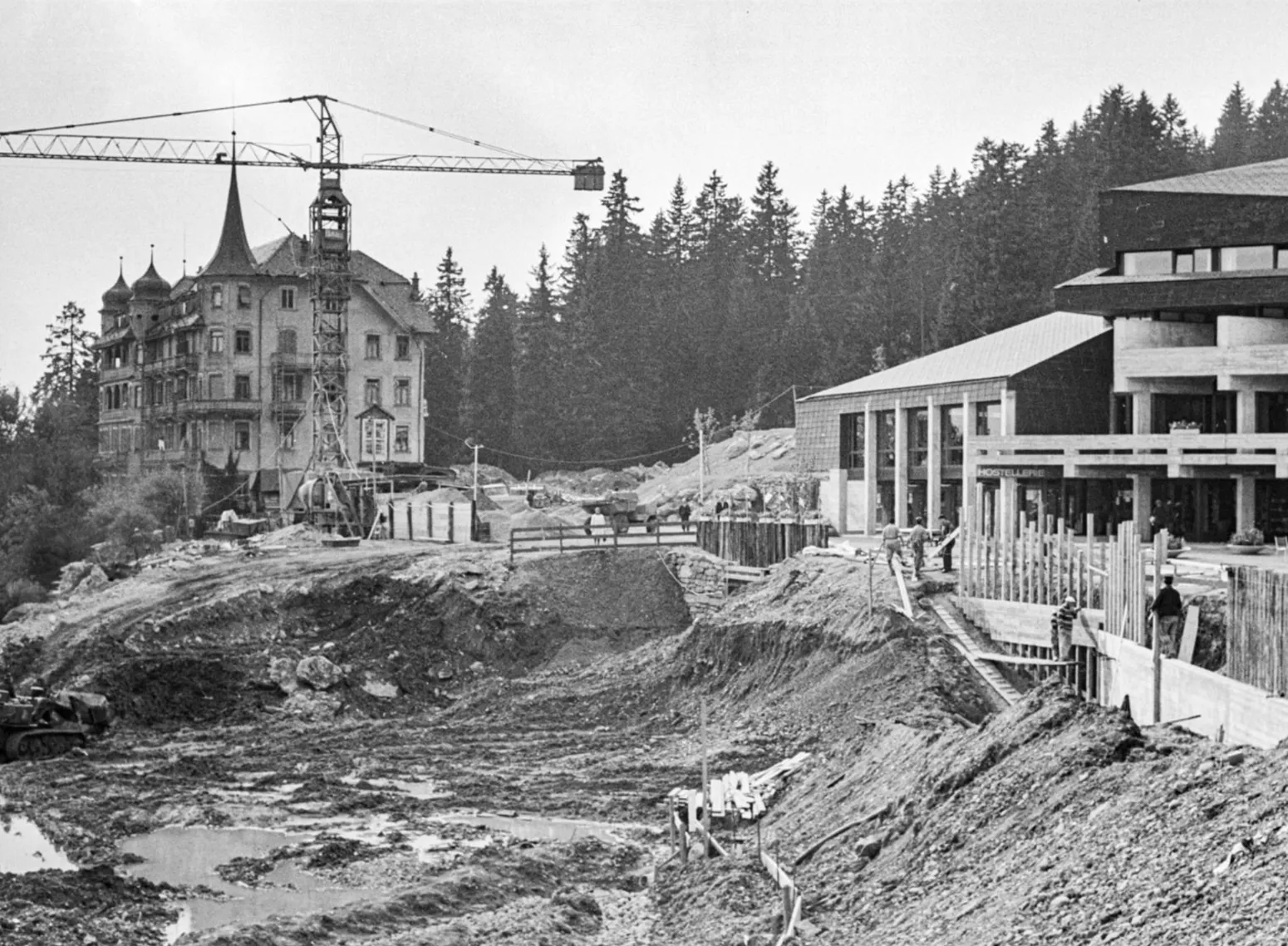
Photo from Archiv-Weggis
The railway was opened on July 15, 1968. It covers 924 meters in altitude over 2.3 kilometers, built by Garaventa. The mountain station was integrated into the newly built hotel and sports complex at Rigi Kaltbad, instead of being placed next to it as a separate building. In 1993, the system received new cabins for 76 passengers; the original ones held 80 people. The travel time is somewhere between ten and seven minutes. It is an aerial tramway with two cabins and three supports, its transport capacity is 650 people per hour.

Land Use Planning, Planning Approval Process, and Design Plan for the New Construction
The first part is land use planning. This is the responsibility of the municipality and is approved by the canton. For a cable car to be allowed to stand in a certain place at all, the route must be secured in terms of spatial planning – in the Weggis case, via a new "cable car corridor" zone in the zoning plan and a re-zoning of the mountain station parcel. The population in Weggis votes on such changes, after which the government council approves them, and an appeal can be lodged against this with the Cantonal Court. Land use planning says nothing about the type of railway.
The second part is the federal planning approval process. The Federal Office of Transport describes it as the equivalent of a building permit: technical regulations, the rights of those affected, and federal provisions on spatial planning, environmental, nature, and heritage protection are examined. With the planning approval, the FOT grants all necessary permits under federal law; no additional cantonal permits are required. The FOT article on the process adds to the process: public display is the first step, in parallel cantonal specialist agencies and federal offices are consulted, then the company comments on the objections, and the FOT, as the procedural authority, tries to resolve differences with the involvement of all parties.
In Rigi Kaltbad, a third, local level is added. The Weggis municipality's design plan leaflet states that for new buildings in the spa and hotel zone and in the zone for railway facilities on Rigi Kaltbad, a design plan is mandatory: before a building permit can be issued, a design plan must be submitted, publicly displayed, and approved. Therefore, the Rigi Kaltbad design plan was a separate milestone.

Photo from 1967 by Archiv-Weggis
The Chronology
Prehistory and System Search, 2015 to 2020
- April 2015 – The Weggis municipal council and Rigi Bahnen sign a letter of intent. The municipality is to invest 1.4 million Swiss francs, divided into an increase in share capital from 50,000 to 1 million francs and an interest-free loan of 450,000 francs; in return, locals will receive higher fare discounts instead of dividends. At that time, a renovation of the existing railway for around 12 million francs from 2017 with continued operation for 25 years was planned, as the Luzerner Zeitung reported.
- October 2017 – After the publication of the "Masterplan RIGI", the first Rigi petition "No! to Rigi-Disney-World" is launched.
- September 2019 – Rigi Bahnen examines and rejects a "3S light" variant proposed by Pro Rigi. The Wikipedia article cites as reasons that although only three supports would have been necessary, significantly larger stations, higher costs, and an undesirably high capacity in the context of the overtourism debate were also factors.
- February 11, 2020 – Double milestone: The expert opinion of the Federal Commission for Nature and Homeland Protection is presented and sees no serious additional impairment, but demands further evidence. At the same time, the winning project "Luegisland" by Graber & Steiger Architekten is presented; eight teams had participated in the competition. At that time, there was talk of 21 gondolas, expandable to 31, and 80 additional parking spaces to the existing 240, as htr.ch summarized at the time. According to Lüchinger Meyer Partner, the "Brigitte" design by Hosoya Schaefer Architects, Ghisleni Partner and Lüchinger Meyer Partner took second place.
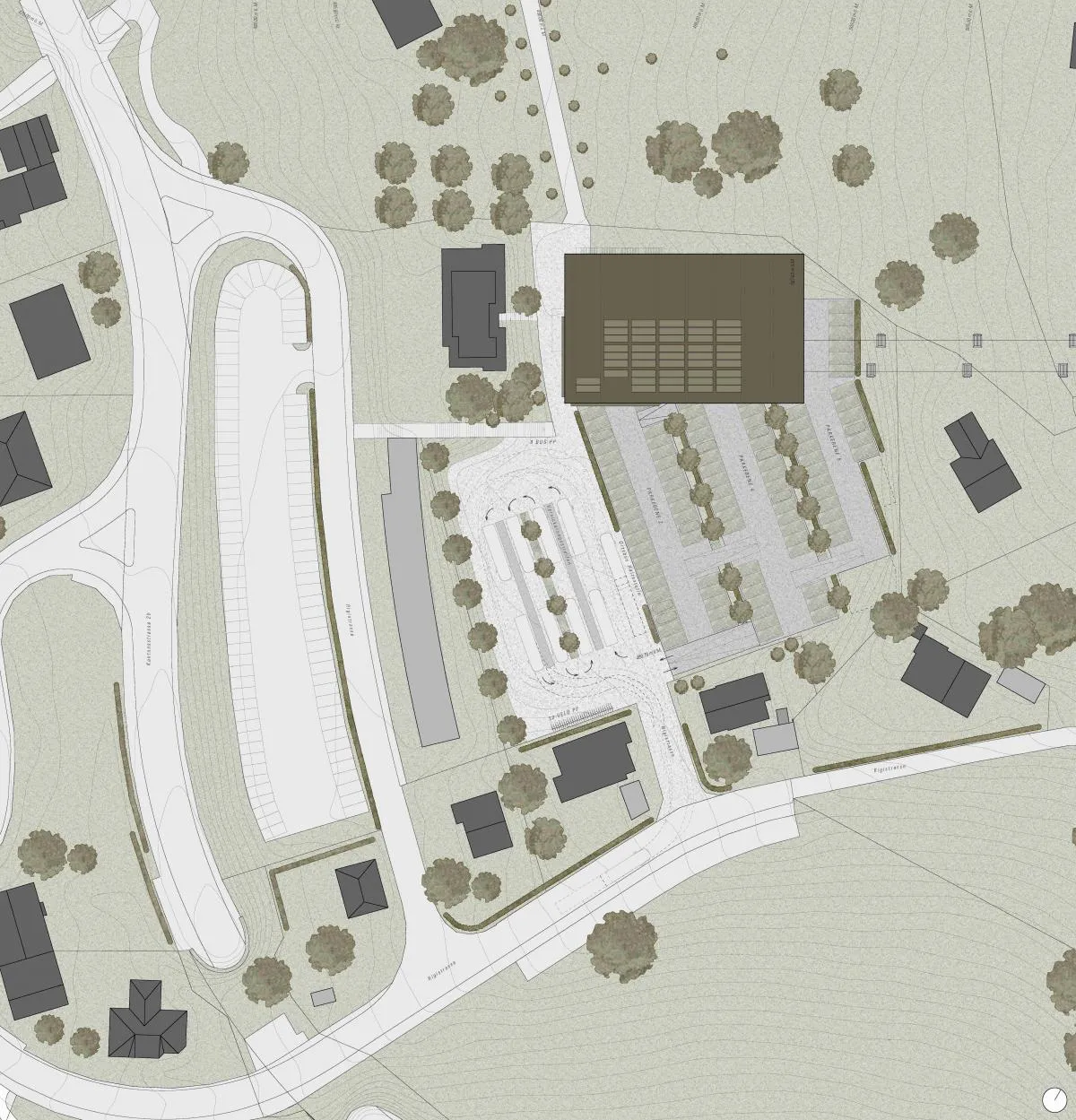
Plan of the valley station from chinese-architects.com
Popular Vote, 2021 to 2022
- March 2021 – The Board of Directors unanimously suspends the winning project and commissions a working group to find a cost-optimized solution. zentralplus quotes the justification that the calculated costs would too severely limit entrepreneurial scope in the long term.
- December 2021 – Decision for a gondola lift with 21 cabins for ten people each, capacity from 650 to 800 people per hour, investments of 20 to a maximum of 25 million francs. Mountain and valley stations each lose one floor, with shops, conference rooms, and parking garage eliminated at the valley station. The details are in the Luzerner Zeitung's report on the downsizing.
- November 15 to December 14, 2021 – Public display of the cable car corridor and rezoning of mountain station parcel no. 1318. According to the petitioners' list, a collective objection from Pro Natura Luzern, WWF Luzern, Landschaftsschutzverband Vierwaldstättersee, Innerschweizer Heimatschutz and Pro Rigi was filed against this, a separate objection from the Stiftung Landschaftsschutz Schweiz and the Stiftung Helvetia Nostra, eleven objections from affected neighbors, and another from a Weggis citizen.
- February 2022 – The ballot scheduled for May 15 is postponed due to the objections.
- August 2022 – The municipality's share purchase falls through. An auditor pointed out that discounts in the absence of dividends would violate the equal treatment of shareholders; instead, the municipality budgets 20,000 francs annually for discounted tickets, as htr.ch reported. The vote on the 1.4 million announced in 2016 therefore never took place.
- November 27, 2022 – The Weggis electorate approves the partial revision with 1259 yes votes to 381 no votes, a yes share of 76.8 percent with 56.2 percent voter turnout; at the same time, 14 objections are rejected. According to SRF, the yes vote contained no statement on the type of cable car and none on forest clearings. Rigi Bahnen itself states a rounded 77 percent on its project page.
The Federal Procedure, 2023 to 2024
- June 2023 – The planning approval process with the FOT begins with the building application. Cable car technology, architecture, environmental impact report, and mobility concept are submitted, among other things.
- June 29, 2023 – The VCS Luzern files an objection. Its core point: the valley station is not meaningfully connected to public transport, although the cantonal master plan requires a connection. The VCS later states that the cantonal specialist agencies supported this assessment and Rigi Bahnen then sought solutions with the transport association.
- July 12, 2023 – The Landschaftsschutzverband Vierwaldstättersee, Stiftung Landschaftsschutz Schweiz and Pro Natura jointly file an objection. Their press release names three main points: 13 supports at eleven locations instead of today's three, with the highest having a construction height of around 74 meters; protective forest will be used at five locations; and the zinc emissions of a gondola lift over its lifespan would be around five and a half times higher than those of an aerial tramway.
- July 14, 2023 – The FOT reports eight timely objections: three from non-governmental organizations, one from an association, four from private individuals.
- July to September 2023 – Because the masts were incorrectly staked out, the public display must be repeated. The second plan display runs from August 16 to September 14, 2023.
- February 2, 2024 – The Government Council approves the cable car corridor and rejects the appeals. The date is mentioned by the Landschaftsschutzverband Vierwaldstättersee in its own statement.
- March 2024 – Two administrative court appeals are filed with the Cantonal Court. The LSVV describes its approach as criticism of the lack of coordination of procedures and the role of the forest in determining land use zones.
- April 4, 2024 – The ENHK confirms its expert opinion. The confirmation is publicly available as a PDF. According to htr.ch, the fulfilled conditions include minimizing noise emissions, reduced forest retention, an optimized truss support, and the protection of dry meadows.
Plan of the new valley station in Weggis from chinese-architects.com
Court Decision and Re-evaluation, 2025 to 2026
- May 13, 2025 – The Cantonal Court of Lucerne partially upholds the appeal and overturns the Government Council's decision. Only one point is upheld: a statement from the responsible clearing authority should have been obtained when defining the cable car corridor, because the corridor affects the forest. On all other points, the court considers the appeals unfounded, and it notes that the new zone is only a spatial planning basis, not a building permit. This is how the Luzerner Zeitung summarizes it. The decision could have been appealed to the Federal Supreme Court.
- January 2026 – Building application for the green parking facility "Vorder Rain", accompanied by a press release on parking and mobility concept.
- February 24, 2026 – The Government Council approves the cable car corridor for the second time. The date is recorded in the valid Building and Zoning Regulations of the Municipality of Weggis, where the cable car corridor is listed as approved by the Government Council, but without legal force. The decision was communicated on March 3, 2026: the cantonal clearing authority found that the project was fundamentally compatible with the forest law, and the details were to be examined and optimized in the federal planning approval process, as swissinfo reported.
- Spring 2026 – Two more appeals are filed with the Cantonal Court. An amicable settlement is reached with one objector, the second appeal remains pending.
- June 14, 2026 – Independently of the cable car corridor, Weggis approves the overall revision of the local planning, with 1535 yes votes to 507 no votes and a voter turnout of 72.23 percent, documented on the municipality's local planning website.
- Early July 2026 – The Weggis municipal council approves the Rigi Kaltbad design plan; it is now legally binding.
- Mid-August 2026 – The FOT approves the project. This means that the building permit for the valley and mountain stations and the route construction is available in the first instance, along with a large number of implementation requirements. Remaining objectors have until mid-September to appeal the decision to the Federal Administrative Court. This can be read in the Rigi Bahnen press release of August 20, 2026.
- August 21, 2026 – Two further building applications are publicly displayed: the reorganization of the lower car park on Rigistrasse West by the municipality with new bus stops and three coach parking spaces, and a lift between the lower and upper arrival levels, with which Rigi Bahnen implements the requirements of the Disability Equality Act.
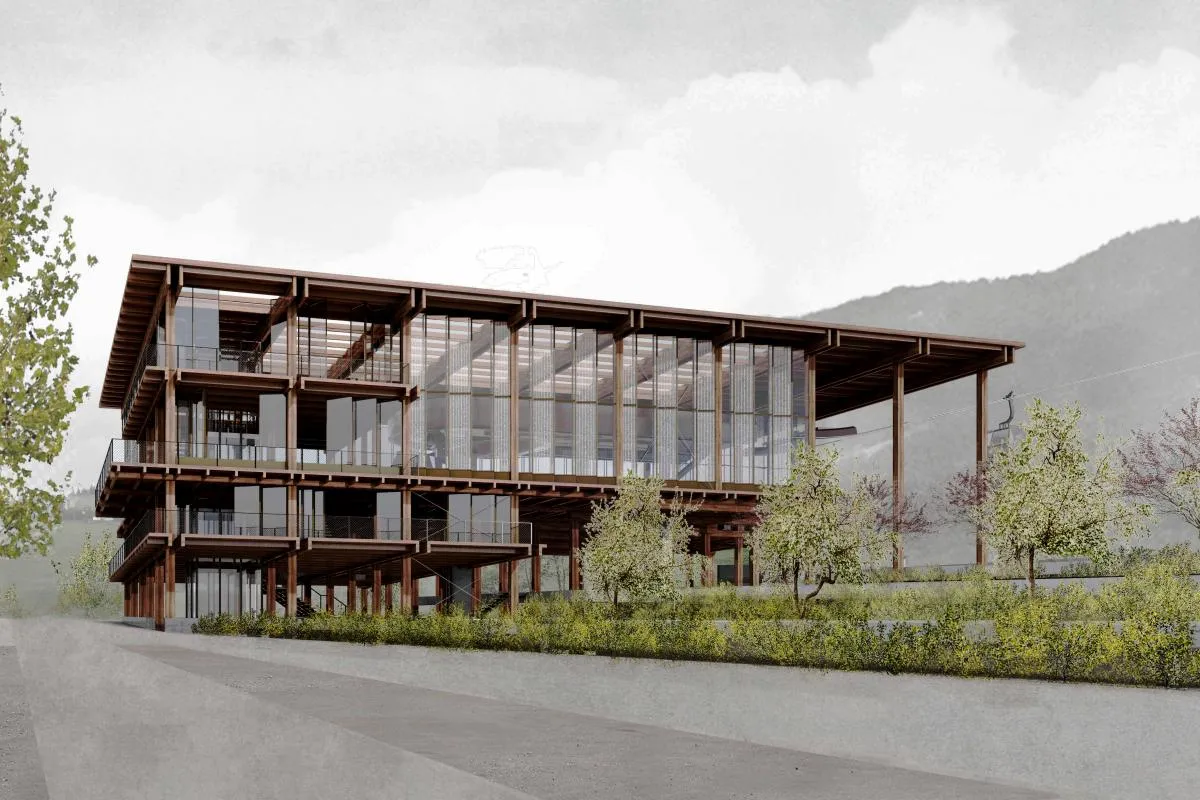
Visualization of the new valley station in Weggis from chinese-architects.com
Changes to the Project
Over the years since 2015, a renovation has become a new construction, a new construction a large project, and the large project a smaller one again. The number of cabins increased from 21 to 22, the number of supports is now 13 at eleven locations, including eleven tubular and two truss supports. For the high support no. 3 below the Chilewald, the decision was made after examining various options for a transparent truss support.
The parking issue was most clearly reversed. In 2020, 80 additional parking spaces were planned in addition to the 240 existing ones; today, Rigi Bahnen writes that the number remains at 261 fixed parking spaces, which would be managed with a modern system. The starting position for public transport connections has also changed: in addition to the Weggis local bus and line 653 from Rotkreuz, bus line 508 from Brunnen and Küssnacht will lead directly to the valley station after opening.
Technically, the project focuses on noise reduction: the drive comes from the Garaventa "D-Line" concept with an underfloor drive, the rope is a Fatzer "Performa rope" with plastic inserts. For the forest, a new retention policy applies, which allows a stand height of at least five meters – the trees in the clearing can therefore grow higher than before, the clearing itself will not be widened. Photovoltaics on the station roofs are expected to cover up to 20 percent of the railway's electricity needs, and the waste heat from the drive up to 10 percent of the energy needs of the neighboring mineral bath.
During construction, an underload transport system on the existing aerial tramway is planned to reduce helicopter flights and temporary construction roads. This very point has an unpleasant side effect: it only works as long as the old railway is still running.
The Numbers That Contradict Each Other
Caution is advised with two values, as different sources provide different information.
For the final expansion, two representations contradict each other. Rigi Bahnen states that the originally planned expansion to 1200 people per hour will be abandoned, and cable car technology such as the gondola garage will be designed in such a way that a later capacity expansion is excluded. The petitioners around René Stettler counter that it is still about a doubling from 650 to 1200.
The costs are currently around 30 million francs – this figure, however, does not come from Rigi Bahnen, but from an analysis report by OTC-X Research dated July 21, 2025. Together with the 12 million for the renovation variant from 2015 and the 20 to 25 million from 2021, this results in a significantly rising curve. Nothing has been built yet: schweizeraktien.net reports that Rigi Bahnen invested a total of 4.05 million francs in 2025, including in overhead lines and in the planning process for the gondola lift.
The Arguments
For Rigi Bahnen, the project is a replacement construction on the same cable axis. They argue that, apart from new mast locations, there will be no new intervention in the landscape, and refer to the ENHK, according to which the silhouette of the mountain landscape will even benefit from the lowering of the cables and the dismantling of the current concrete masts. Regarding comfort, they state that every guest can sit in the ten-seater cabins, that operation works without a timetable, and that each gondola stops completely in the station, allowing barrier-free boarding without a difference in level. On days with low frequency, convoy operation with three gondolas per direction is possible, which corresponds to the current half-hourly service.
The opposing side argues along the lines of landscape, forest, and growth. The Landschaftsschutzverband and its partners consider the gondola lift in the rockfall and landslide-prone protective forest of the Rigi south slope to be the wrong system and point out that a replacement aerial tramway at the existing support locations would require almost no additional clearings. The petitioners have been demanding a one-to-one replacement with two cabins and three masts for years, arguing that an aerial tramway crosses over the terrain, withstands stronger winds, and is faster.
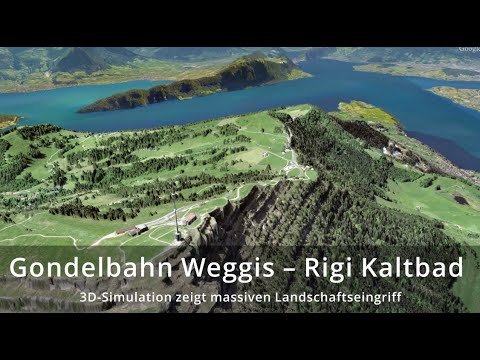
YouTube Video by René Stettler
Sources
Rigi Bahnen provides an unusual amount of information on its project page: the mobility concept, the noise protection certificate for road and parking, the visualizations of landscape and supports as well as an illustration of convoy operation. The opposing side operates a press archive on the topic at rigi-800000-sind-genug.ch.
However, the objections themselves, the public display dossier of the planning approval process, and the FOT ruling from mid-August 2026 are not public. Only the public display is published, not the ruling; the public displays appear in the Luzerner Kantonsblatt as the official publication organ. Lucerne decisions are generally accessible via the jurisprudence page of the Lucerne courts.
What's Next
The next hard deadline is mid-September 2026, when the deadline for appealing the FOT ruling to the Federal Administrative Court expires. If it is used, the federal track will be delayed by years. If it is not used, the cantonal part remains: as long as the appeal against the cable car corridor is pending, the approval process cannot be legally concluded, and theoretically, the path to the Federal Supreme Court is still open afterwards.
In parallel, discussions are ongoing with the FOT about a further extension of the operating permit. This would require, among other things, revision work on the 1968 system. Rigi Bahnen is not currently naming a new opening date. Most recently, in March 2026, there was still talk of summer 2028.
Further Sources
- rigi.ch Project SMART - Renewal of the cable car
- Rigi: 800,000 is enough
- rigi.ch Press Release / August 20, 2026 - Steps forward in the replacement of the Weggis aerial tramway
- rigi.ch Press Release / May 1, 2024 - Positive assessment of the Weggis-Rigi Kaltbad gondola project by the Federal Commission for Nature and Homeland Protection (ENHK)
- Minutes of the 32nd ordinary general meeting of the shareholders of RIGI BAHNEN AG
- IPSO ECO - Weggis-Rigi Kaltbad aerial tramway, Rigi – New gondola circulating ropeway
- IG Pro Gondelbahn Weggis
Status: August 21, 2026.