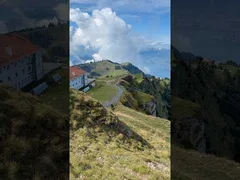
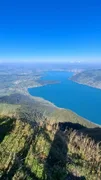
The Rigi, often called the "Queen of the Mountains," rises majestically above Lake Lucerne and forms a striking topographical boundary between the cantons of Lucerne and Zug. Yet, far beyond its geographical presence, the Rigi has gained profound cultural and historical significance, particularly in European landscape painting of the 18th and 19th centuries. In art history, the mountain stands not only for a physical mass of rock but for the aesthetic discovery of the Alps, the search for the sublime, and the fascination with fleeting atmospheric light.
The Significance of the Mountain for Painting
Until the late 18th century, mountains in fine art were often seen only as a threatening backdrop or as a purely symbolic background for historical and religious scenes. With the Romantic era, this view changed radically. Landscape painting was elevated, and the Rigi became a central motif. For the painters of that time, the massif embodied the "sublime" – a mixture of awe-inspiring natural power and ethereal beauty.
The exposed location of the Rigi, surrounded by lakes and often shrouded in dense fog or haze, made it an ideal subject for studying atmospheric phenomena. Artists were increasingly less concerned with the exact topographical surveying of the rocks and more with capturing moods, weather changes, and the specific alpine light.
Where Does the Rigi Appear in Painting?
The Rigi became most famous through the works of the British painter William Turner (1775–1851). Turner traveled to Lucerne several times in the mid-19th century to study the mountain from there in countless sketches and watercolors. From his hotel room in Lucerne, he tirelessly gazed at the massif and created color studies of unprecedented modernity.
His three most famous works on this motif – the Blue Rigi, the Red Rigi, and the Dark Rigi (created around 1842) – show the mountain in different lighting conditions. In these paintings, the solid matter of the rock seemingly dissolves into pure color, water, and light. Turner applied the watercolor and gouache paints heavily diluted and washed, making the mountain massif appear partly transparent, like a fleeting veil. These almost abstract-looking works are now considered milestones in art history and made the Rigi an iconic motif of longing throughout Europe.
Painters on the Rigi: Artworks on the Mountain
While Turner mostly painted the mountain from a distance (from Lucerne or the lake), the Rigi itself developed into a place of creation. With the advent of early alpine tourism – which was fueled not least by its visual popularization in art – artists and travelers flocked up the mountain. The historical infrastructure, which led up from Weggis via early mule tracks to the higher elevations, was often part of these artistic pilgrimages. People ascended to experience the famous spectacle of the sunrise from Rigi Kulm.
However, the mountain was not only a viewpoint but also offered lodging and studios. Rigi Kaltbad, in particular, a historically significant place for those seeking recreation and travelers, attracted many artists over the decades.
- August Cueni (1883–1966), who later became known as a landscape painter (the "Cézanne of the Laufental"), gained early impressions of the region when he worked in the traditional Hotel Rigi-Kaltbad in 1902 before beginning his painting apprenticeship.
- Swiss mountain painters like Ernst Hodel also intensively engaged with the immediate alpine environment and found their most important motifs in the elevations of Central Switzerland.
- The artistic presence on the mountain extended far into the modern era. The Zurich painter and glass artist Max Truninger (1910–1986) created an impressive glass painting for the chapel in Rigi Kaltbad in 1963. Here, artistic design merges directly with the local architecture and the history of the settlement.
- Furthermore, the Rigi has repeatedly been a venue for exhibitions in recent times, where artworks were not only about the mountain but were presented on it. For example, the Hostellerie in Rigi Kaltbad dedicated an exhibition to the painter Hannes Gruber in 1969, underscoring the ongoing connection between gastronomy, tourism, and art on the mountain.
The Rigi and Painting
The significance of the Rigi for painting is dual: On the one hand, from a distance, it was a luminous projection surface for romantic light and color experiments, masterfully captured by William Turner. On the other hand, it was a real, physically experienced place. Through the development of historical paths from Weggis up to stations like Rigi Kaltbad, the mountain itself became a place of residence and work for artists whose works are still firmly inscribed in regional and international art history.