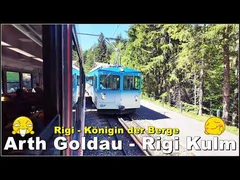
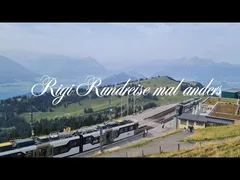
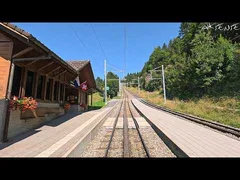
On May 21, 1871, a hissing, steaming train crawled up the mountain from Vitznau on Lake Lucerne for the first time. It was, incidentally, the 54th birthday of the man at the controls: Niklaus Riggenbach. And it was the birth of Europe's first mountain railway. Anyone who today sits comfortably in one of the red railcars and watches the lake disappear below them rarely suspects what a tangled physical, financial, and political nut had to be cracked back then. This article tells the story – with numbers, with formulas, and with a few conjectures where the sources are silent.
If you are interested in the details of today's railways, you can find the current fleet of cogwheel and aerial cable cars on the Rigi Bahnen overview. But let's jump back to the mid-19th century first.
A fashionable mountain without reasonable access
Long before the railway, the Rigi was a place of longing. "Queen of the Mountains," sunrise over the sea of fog, painters and poets from half of Europe – the Rigi was an early prototype of alpine mass tourism. The only problem: anyone who wanted to go up had to walk, ride, or be carried up in a sedan chair by porters. For a wealthy but increasingly comfortable public, this was a bottleneck. Precisely this congestion of demand and lack of development is the real driving force behind the whole story. One could put it this way: it wasn't technology looking for a mountain, but an overcrowded mountain looking for technology.
The engineer and his ridiculed model
Niklaus Riggenbach, born in 1817 in Guebwiller, Alsace, was a trained mechanic and had worked his way up to locomotive builder in Karlsruhe and later at the Schweizerische Centralbahn in Olten. The idea of having a train's cogwheel engage with a fixed rack to conquer steep ramps never left him. As the Deutsche Biographie notes about Riggenbach, his model was initially met with shrugs in expert circles; even in Stuttgart, people whispered that "old R. had gone mad." Only the famous engineer Carl Culmann from the Zurich Polytechnic encouraged him.
Because Switzerland did not yet have a patent system at the time, Riggenbach had his gearing protected in France on August 12, 1863 – under French patent number 59625. This is a detail to remember: the heart of European mountain railway history is originally a French patent by a Basel native born in Alsace.
The decisive impetus then came by chance from overseas. At about the same time and completely independently, the American Sylvester Marsh had built the Mount Washington Cog Railway in New Hampshire – the world's first cogwheel mountain railway, officially opened in 1869, with about 1200 meters of altitude and an average gradient of 250 ‰. When the Swiss Consul General in the USA, John Hitz, saw this railway and enthusiastically reported back to Bern, and when the same Hitz later saw Riggenbach's model in Olten, he is said to have exclaimed: "Well, Mr. Riggenbach, you are building a railway on the Rigi!" With that, Riggenbach's tinkering had a concrete goal. The technology of the two systems is strikingly similar – Marsh used round bars as teeth, Riggenbach flat rungs – which still leaves open the intriguing question of who knew about whom. The sources clearly point to a double invention: Riggenbach's patent from 1863 is six years older than Marsh's finished railway.
Before going to the mountain, Riggenbach tested his system on flat ground: Europe's first actually operating cogwheel railway was already running in 1870 in the Ostermundigen quarry near Bern – for marketing reasons, it was even officially "opened" only after the Rigi railway. So the Rigi was not the test object, but the stage.
Construction, opening – and a cantonal spirit thriller
In mid-September 1869, construction began from Vitznau (439 m above sea level). Riggenbach worked with engineers Ferdinand Adolf Naeff and Olivier Zschokke. On his birthday in 1870, the first test run took place on a 300-meter section, and a year later, on May 21, 1871, the line to Rigi Staffelhöhe (1550 m above sea level) was ceremonially inaugurated – in the presence of no less than four Federal Councillors. The whole project was financed purely privately; as the database on historical Swiss railways notes, banks from Basel and Lucerne were primarily involved. Success was immediate: the railway soon transported over 100,000 guests to the mountain annually.
Then it got political. The lucrative last section from Staffelhöhe up to Rigi Kulm (1752 m above sea level) is located in the canton of Schwyz – and Schwyz refused the Lucerne railway the concession. As the municipality of Arth describes in its cultural trail, the canton instead granted the permit to an Arth committee. The result: from Staffel, two parallel tracks run side by side to this day, built by two competing companies. Although the Vitznau-Rigi-Bahn reached Kulm as early as June 27, 1873, it had to pay rent for the foreign track section for decades. The separate Arth-Rigi-Bahn was opened on June 3, 1875. Only in 1992 did the two arch-rivals merge to form today's Rigi Bahnen. My assessment: This double-track compromise is railway-technical nonsense and a federalist monument at the same time – a more expensive, redundant system that is exclusively due to the cantonal border. As a testament to the power (and cost) of the Swiss cantonal spirit, however, it is priceless.
Why it needs teeth at all – the physics of the steep ramp
Now to the technical core. A normal "adhesion railway" propels itself solely by the friction between steel wheel and steel rail. The maximum tractive force that a locomotive can generate is
F_Zug = μ · G_Reib
where μ is the coefficient of friction or adhesion and G_Reib is the weight acting on the driven axles. To climb a slope, this tractive force must overcome the downhill force plus the rolling resistance:
F_Zug ≥ m · g · sin α + m · g · f · cos α
If one neglects the small rolling resistance and assumes that the entire vehicle weight rests on the driving axles, the limit simplifies to the neat rule of thumb
sin α_max ≈ μ.
And this is precisely the problem. Dry, clean steel on steel ideally achieves μ ≈ 0.25–0.33, but in wet, leafy, operational everyday life, it is more like μ ≈ 0.15–0.20. The House of Switzerland puts it succinctly: Pure adhesion trains reliably manage a maximum of about 4% (40 ‰). Anything above that requires help.
Let's calculate it specifically for the Rigi. The Vitznau-Rigi-Bahn has a maximum gradient of 250 ‰, or 25%. This corresponds to an angle of
α = arctan(0.25) = 14.04°, with sin α = 0.2425 and cos α = 0.9701.
Per ton of train weight (1000 kg, g = 9.81 m/s²), this results in:
- Downhill force: F_Hang = 1000 · 9.81 · 0.2425 ≈ 2379 N ≈ 2.38 kN per ton
- Rolling resistance (with f ≈ 0.003): F_Roll = 1000 · 9.81 · 0.003 · 0.9701 ≈ 28.5 N per ton
- Total: approximately 2.41 kN per ton, which must go through the rack.
And the crucial comparison: to conquer these 250 ‰ without a rack, one would need an adhesion coefficient of
μ_erf = sin α + f · cos α ≈ 0.242 + 0.003 ≈ 0.245.
Even under ideal conditions, the real friction coefficient is barely above this – and in operation, it is far below. For a locomotive that also pulls unpowered wagons (only the locomotive weight is then "adhesion weight"), the situation is ultimately hopeless. Hence the tooth. The rack completely bypasses the friction limit and establishes a positive, i.e., purely geometric, engagement that is practically unaffected by wetness, leaves, or frost.
The ladder rack in detail – dimensions, modules, moments
Riggenbach's solution is the so-called ladder rack: between two ]-shaped rolled steel webs, trapezoidal teeth are inserted like rungs of a ladder (originally riveted, later welded). The Bahnmuseum Appenzellerland vividly describes the elaborate manufacturing process – and at the same time names the biggest disadvantage of the system: the riveting of the webs and the punching out of the trapezoidal holes is expensive.
The hard facts are provided by the technical system description at Trackopedia: The tooth pitch is 100 mm, a standard Riggenbach profile is 3 m long and thus carries 30 teeth. Because these rigid profiles cannot be bent arbitrarily, they are also available in two fixed radii of curvature – the Rigi itself works with a minimum radius of 60 m. It runs on standard gauge (1435 mm), which is unusually generous for a mountain railway.
From the pitch, the gearing geometry can be derived. For an involute gearing, the pitch p = π · m, so the module is
m = p / π = 100 mm / π ≈ 31.83 mm.
This is, compared to normal mechanical engineering, a gigantic module – a tooth as big as a thumb. The pitch circle diameter of a drive cogwheel with z teeth then follows directly from
d = m · z = z · p / π.
If one calculates with a small drive wheel of z = 12 teeth as an example (the exact historical number of teeth varies and is marked here as an assumption), d ≈ 382 mm results. The drive torque applied to the cogwheel per ton of train weight would then be
T = F_t · d/2 ≈ 2410 N · 0.191 m ≈ 460 N·m per ton.
For a historical train consisting of a steam locomotive and a fully occupied leading car (roughly estimated 25 t total mass), this means: approximately 60 kN of tooth force on the ramp. This force had to be cleanly introduced into the ground by the ladder rack – trip after trip, for decades.
And the power? The steam locomotives traveled uphill at about 9 km/h (2.5 m/s). The pure lifting power is
P_Hub = F_Hang · v ≈ 2379 N · 2.5 m/s ≈ 5.95 kW per ton.
For our 25-ton example train, this is a good 149 kW just for lifting (about 200 HP), before rolling and internal losses are even added. For a vertical boiler steam locomotive built in 1873, this was a statement – it is no coincidence that the chronicle of the Vitznau-Rigi-Bahn reports that the restored locomotive 7 with its new boiler could no longer manage to pull a fully occupied large car up the 250 ‰ gradient in 1996/97.
The competition of systems – and a deadly failure
Riggenbach's rack was a pioneering solution, not an endpoint. Around the Rigi era, several systems vied for the best answer to the steep ramp. The overview of rack railway systems shows that the four best known all originated from Switzerland:
- Riggenbach system – the ladder rack described. Robust, but expensive and rigid in manufacturing.
- Strub system (Emil Strub) – a single broad-footed rail, into the head of which the teeth are milled. Significantly cheaper and easier to lay; can be used with the same cogwheels as Riggenbach, provided the pitch and pitch circle height are correct. Used, among others, on the Jungfraubahn.
- Abt system (Carl Roman Abt) – two or three "lamellae" of flat steel lying next to each other, offset by half a pitch, so that a tooth is always in engagement. Remarkable: Abt had previously worked for Riggenbach's own company and explicitly developed his system to circumvent its high costs.
- Locher system (Eduard Locher) – for the most extreme gradients. Here, the cogwheel does not engage from above, but with horizontal teeth laterally into a double-sided rack, which prevents climbing out. This is how the Pilatusbahn, opened in 1889, runs its 48% (480 ‰) – still the steepest cogwheel railway in the world.
Later, the Von-Roll lamella rack was added, which replaced the expensive Riggenbach and the no longer available Strub profiles from the 1960s onwards and simply adopted the old gearing geometry in milled flat steel.
The most exciting side path of history, however, is a failed one. The Zurich cantonal engineer Kaspar Wetli wanted to avoid the tooth entirely and instead devised the Wetli roller wheel system: a wide, toothed roller filling the entire space between the rails, which engages with arrow-shaped mounted rail sections. It was intended to open up the Wädenswil–Einsiedeln railway line with its 50 ‰, because a pure adhesion railway was rightly mistrusted at this gradient. On November 30, 1876, disaster struck during the main test: the uphill journey succeeded, but on the downhill journey, the roller was disengaged (it was not intended for braking at all) – and precisely the conventional brakes failed, presumably because leaked oil got onto the rails and wheels. The train sped into Wädenswil station at an estimated 120 km/h, overturned, and people died.
The bitter irony: it was not the roller wheel system that had failed, but the brakes. Nevertheless, trust was gone, the Nordostbahn withdrew, and the line was completed as a simple adhesion railway. My conjecture: If this accident had not happened – or if the investigation had been as soberly separated between "system error" and "brake error" as we would naturally do today – then Wetli's roller might be in a footnote next to Riggenbach instead of in a footnote under him. The case is a lesson in how a single, media-hyped catastrophe can wipe out an entire technical line, regardless of its actual suitability.
Then versus now – the same formulas, new levers
The fascinating thing about the Rigi railway is how little the physics have changed and how much the technology has. The basic equations of 1871 – F_Zug = μ · G_Reib for adhesion and F = m·g·(sin α + f·cos α) for driving resistance – are still unchanged in every textbook today. What has changed are the levers within these equations.
The biggest break was electrification in 1937: Since then, the railway has been running on 1500 V DC, supplied by several rectifier stations. The steam locomotive with its tired 9 km/h gave way to railcars that travel uphill at 18 to 23 km/h. The electric motor delivers its torque immediately and over the entire speed range – no more starting with laboriously built-up boiler pressure. The biggest physical gain, however, lies in the downhill journey: a modern railcar can use its motors as generators and regeneratively brake, i.e., feed part of the potential energy of the descent (after all, those ~5.95 kW per ton that were put into it uphill) back into the grid, instead of simply burning it off as heat like the old block brake. Conjecture: Precisely this point – the downhill journey as a braking problem – was the unsolved core problem in Wädenswil as early as 1876. What caused the Wetli catastrophe, the electric drive elegantly solves today as a side effect.
And yet: The tooth pitch of 100 mm from 1871 is still valid today. Modern vehicles engage with the same geometry as Riggenbach's ancestors; Von-Roll lamellae and Riggenbach profiles are mutually compatible. This is a remarkable technical continuity over 150 years – a standard that has lasted a lifetime because it was cleanly defined from the start. If I draw one lesson from this, it is this: a well-chosen, openly compatible standard is often more durable than the most brilliant individual innovation.
What the railway meant for the Rigi
The impact of the Rigi railway can hardly be overestimated. It was not merely a means of transport; it was a business model and a blueprint at the same time. Four years after its opening, the Arth-Rigi-Bahn followed, and shortly thereafter an avalanche of alpine cogwheel railways throughout the Alpine region, culminating in the Jungfraubahn, completed in 1912, reaching 3454 m. The mountain, which was previously only accessible on foot or on the back of a mule, became a fully industrialized excursion destination for a mass audience within a few years.
From today's perspective on the Rigi as a residential and holiday region – for example in Kaltbad, which the railway has served since 1871 and which is still car-free today – it becomes clear how deeply this infrastructure has shaped the mountain's identity. The rack is not nostalgia here, but still the lifeline. The mountain is literally built on rails.
My final assessment: The Rigi railway was less a technical stroke of genius out of nowhere – Marsh was there almost simultaneously, Wetli had a serious alternative, the Abt, Strub, and Locher systems partly surpassed Riggenbach – than a perfect confluence of mature technology, tourist demand, and courageous private capital in exactly the right place. Riggenbach's real achievement was not just the gearing, but the nerve to dare to implement it on a large scale for the first time on one of Europe's most famous mountains. That precisely the most expensive and elaborate of the early racks made the beginning is a quirk of technical history – but one that still travels up the mountain punctually every morning for 150 years.