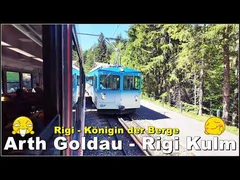
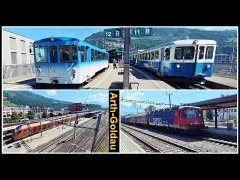
If you stand on Rigi Staffel on a Sunday in August, you can see four generations of propulsion systems pass by within an hour, covering approximately 150 years of technological history: a steam locomotive with a vertical boiler from 1873, an electric railcar from 1911, a push-pull train from the 1980s, and a Stadler articulated railcar that feeds electricity back into the grid when descending. All four run on the same rack system. This is the real reason why Rigi is more interesting for railway engineers than almost any other Swiss mountain.
Two Railways, One Mountain, One System
Two separate standard-gauge lines operate on Rigi, both belonging to RIGI BAHNEN AG since 1992. From the south comes the Vitznau-Rigi-Bahn, opened in 1871 as Europe's first mountain railway, almost seven kilometers long, with gradients of up to 250 per mille and a minimum curve radius of 60 meters. From the north comes the Arth-Rigi-Bahn, opened on June 4, 1875, 8.55 kilometers long, with a maximum gradient of 201 per mille and a minimum radius of 120 meters.
Both use the Riggenbach rack system and both are electrified with 1500 volts DC, fed from the national grid via rectifier stations. This very congruence makes today's operation possible. Until 1990, the two companies ran on parallel but separate tracks from Rigi Staffel to the common terminal station Rigi Kulm; the only connection was a hand-operated traverser. It was not until June 12, 1990, that the facilities in Rigi Staffel were connected with two switches, allowing direct vehicle exchange and paving the way for the merger, as the overview of the Rigi Bahnen notes.
Historically remarkable is the order of electrification: The Arth-Rigi-Bahn switched to electric operation as early as May 1, 1907, making it the world's first standard-gauge rack railway with electric traction. The Vitznau side only followed on October 3, 1937. The older railway thus ran on steam for 30 years longer than its competitor.

Why the Rack System Determines the Entire Vehicle Construction
On a normal adhesion railway, the wheel transmits both driving and braking force to the rail. Above a gradient of about 40 per mille, the friction is no longer sufficient for this. On Rigi, the rack system is therefore continuous, from the valley station to the summit, without a single adhesion section.
This leads to a consequence that Stadler has consistently thought through for the latest vehicles: If the wheel does not have to transmit force, it can run freely. In the articulated railcars, the running wheels are therefore decoupled from the drivetrain, which reduces wheel and rail wear. And because a block or disc brake acting on the wheel would achieve little on these gradients anyway, it is completely dispensed with. The entire braking force flow runs via the gearwheel and band brakes, as the technical description of the Bhe 4/6 explains.
In older electric railcars, the braking philosophy is similar, but mechanically implemented differently. According to the data sheets for BDhe 4/4 5 and BDhe 4/4 15, 21–22, vehicles built between 1964 and 1986 have a gear brake, a pawl brake, and a spring-applied brake. The pawl brake is the ultimate safety feature: it engages positively and only allows movement uphill.
The second major difference between old and new concerns energy. A train traveling from Rigi Kulm to Vitznau releases about 1300 meters of potential energy. With the DC series-wound motors of the old generation, this energy could practically not be fed back into the grid; it was dissipated in resistors. The Rigi Bahnen clearly state the difference in their project page for rolling stock procurement: The old fleet dissipates braking energy, while the new one feeds it back into its own grid, where it benefits uphill-traveling trains.
Steam: Two Opposing Answers to the Same Problem
Today, the Rigi Bahnen operate three steam locomotives in their fleet: numbers 7, 16, and 17.
The H 1/2 No. 7 dates from 1873 from the Swiss Locomotive and Machine Works in Winterthur and is the most technically idiosyncratic vehicle on the mountain. It weighs 11.7 tons, produces 88 kilowatts, and travels at 7.5 kilometers per hour. Its distinguishing feature is the vertical boiler. The reason for this is pure safety physics: at a gradient of 250 per mille, the water level in a horizontal boiler shifts so much to the rear that the fire-touched heating tubes at the front can run dry, with the risk of a boiler explosion. A vertical boiler hardly experiences this problem. The Rigi Bahnen explicitly describe this consideration in their chronicle of locomotive 7.
The vertical boiler had operational disadvantages, which is why almost all Rigi locomotives were converted to horizontal boilers between 1882 and 1892, including number 7 in 1892. With electrification in 1937, the steam fleet became redundant; number 7 escaped scrapping because it was externally restored to its original condition for the 1939 National Exhibition. From 1959, it was displayed in the Swiss Museum of Transport, in 1996 it was made operational again for the first time, and after restoration funded by crowdfunding from the Rigi Historic Foundation, it is now the world's only operational rack steam locomotive with a vertical boiler.
The two H 2/3 numbers 16 and 17 from 1923 and 1925 show the other solution. They have horizontal boilers because these are easier to clean. To mitigate the water level problem, the boiler and superstructure are installed at an angle, so that they are horizontal on the downhill section, as the description of the VRB H 2/3 explains. The machines weigh 24.3 tons, produce 340 kilowatts, and travel at 9 kilometers per hour. After World War II, they were regularly used in scheduled service when the railcars could not cope with the crowds; since an overhaul between 1969 and 1971, they have been nostalgia vehicles.
A figure that illustrates the effort involved: one of these locomotives must be fired for four hours before it can run, as the Rigi Bahnen state on their steam trips page.

The Electric Pioneers That Are Still Running
On the Goldau side, there is a vehicle that holds a world record. Railcar number 6 from 1911, built by SWS, SLM, and Maschinenfabrik Oerlikon, is, according to the article on ARB BCeh 2/3, the oldest operational electric rack railcar in the world. It weighs 23.5 tons, produces 390 kilowatts, and offers 50 seats.
Its history is also a financial history. The Arth-Rigi-Bahn could not afford the car itself in 1911. A consortium financed it, and the railway initially leased it and paid it off in installments. For it to be put into service at all, the traverser in Arth-Goldau had to be extended by two meters. In 1939, the power was increased from 260 to 530 hp, which increased the speed from 12 to 15 kilometers per hour. In winter, the powerful car was often used as a snowplow, as the Rigi Bahnen note in their ARB chronicle.
Fourteen years later, the Arth-Rigi-Bahn presented itself with railcar number 7 for its 50th anniversary. It resembles number 6 but has four axles and more power, so it could push up to two additional cars uphill. Only then, as the article on ARB BCeh 2/4 7 describes, was it possible to dispense with regular steam operation. A conversion in 1939 increased the power from 288 to 610 hp.

From Push-Pull Train to Solitary Runner
Between 1937 and 1986, the fleet that supported operations until a few years ago was built, and it falls into two schools of thought.
The Arth-Rigi-Bahn opted for push-pull trains early on. The four railcars numbered 11 to 14, delivered in 1949, 1954, and 1967 by SLM and Geneva-based SAAS, were supplemented with matching control cars from 1958. They produce 480 kilowatts, weigh around 26.5 tons, and travel uphill at 21 kilometers per hour. Only one axle per bogie is driven, as the data overview for ARB CFeh 2/4 11–14 shows. The blue and white livery with fading dots, which the vehicles received between 2005 and 2006, is internally called the "snowflake livery"; the red of the Vitznau sister vehicles is called "berry." In 2022, motor car 12 and control car 22 were restored to their 1949 delivery condition, both inside and out, including original wooden benches and old chrome numbers.
Vitznau took the opposite approach and long acquired single vehicles. The Bhe 2/4 delivered in 1937 produce 330 kilowatts, weigh 16.7 tons empty, and have their two motors and brakes in the uphill bogie; a pure running bogie runs downhill. A striking peculiarity, easily overlooked in photos, is that the entrance doors are only on the side facing Lake Lucerne.
In 1964, the BDhe 4/4 number 5 followed, known as Füfi in operation, with 752 kilowatts and 35.3 tons. At its uphill front, there is a gangway door for a control car that was never built because it was too expensive; already manufactured parts went into the spare parts warehouse.
A special case is the He 2/2 number 18 from 1938, the only electric locomotive on the mountain. It arose from a cost calculation: a locomotive was initially estimated to be 40,000 francs cheaper than a fourth railcar. Due to inflation, it ultimately cost 87,170.55 francs and was still about 18,000 francs cheaper. Since a conversion in 1974, it has a second pantograph with a steel skid, which can be used to clear the overhead line of hoarfrost and ice, and it pushes the snowplow up the mountain.
Finally, in 1982 and 1986, three largely identical push-pull trains arrived, numbers 15 for Goldau and 21 and 22 for Vitznau. They produce 824 kilowatts, develop 160 kilonewtons of hourly tractive effort, and have four driven gearwheels. The only external difference between the two Vitznau trains is the headlights: round on 21, angular on 22.

The cars in front are called "Vorstellwagen" (additional cars) on Rigi because they are placed in front of the traction unit and pushed uphill. The oldest date from 1871 and 1875. The current stock includes the open summer car number 11 with the nickname Bambus, car 14 built in the company's own workshop in 1902 with seats on the brakeman's platform, and the two Belle Époque saloon cars converted in 1988 and 1992.
The Stadler Generation
Since April 2022, regular service from Vitznau has been exclusively operated by six two-car articulated railcars of type Bhe 4/6, built by Stadler in Bussnang, designed by Milani Design in Thalwil. They bear the names of travelers from the 18th and 19th centuries: Thomas Cook, Victor Hugo, Johann Wolfgang von Goethe, Mark Twain, Queen Victoria, and Rosa Dahinden-Pfyl.
The key data according to Rigi Bahnen: 34.8 meters long, 3 meters wide, 150 seats and 50 standing places, operationally 20 kilometers per hour uphill and 17.5 kilometers per hour downhill on a 250 per mille gradient. Two vehicles can be coupled into a double traction approximately 70 meters long, operated by a single driver.
Technically, there is a powered bogie at each end of the vehicle, and a non-powered and non-braking Jacobs bogie connects the two car bodies in the middle. Power is supplied by four three-phase asynchronous motors, fed from two water-cooled IGBT converters on the roof. The motor supplier Traktionssysteme Austria specifies for type TMF 42-32-4 250 kilowatts of power, 1256 Newton meters of starting torque, and 580 kilograms of mass per motor. Four of these result in approximately one megawatt of installed power, significantly more than any predecessor.
It is remarkable how much the mountain influences the interior. The seats are slightly inclined relative to the horizontal to compensate for the gradient. The driver's cab occupies only half the width of the car inside, so passengers can look forward, and the equipment cabinet next to it is designed as a couch. According to the factsheet, there are also drop-down windows instead of air conditioning, ski racks with drainage, a laser-based collision warning system, and a so-called icebreaker circuit for icy overhead lines.
The color scheme is a deliberate quote: white, black, and bronze echo the colors of railcar number 6, which marked the beginning of electrification in 1911, 110 years later.
It is also worth mentioning that the launch was not entirely smooth. During commissioning on April 7, 2022, the newly christened car 45 had to turn back shortly after departing Vitznau due to a door malfunction, as Bahnonline reported on the event; number 44 took over.
What Will Actually Run in 2026
From Vitznau, only the Bhe 4/6 will operate in scheduled service. From Goldau, push-pull trains numbered 11 to 14 and composition 15 will continue to be used. Vehicles 5, 21, 22, the two remaining Bhe 2/4, and locomotive 18 are available as reserves, for extra trains, and for freight transport. Historic cars 6, 7, and 12 are used for nostalgia trips.
Public steam trips from Vitznau in 2026 will take place with locomotive 16, according to the Rigi Bahnen booking page on April 26, May 24, June 28, August 1 and 2, August 23 and 30, September 6 and 20. On the days designated as Rigi Historic XXL in May and on August 1, all scheduled trains will be operated with historic vehicles. Locomotive 7 has been on display in a free permanent exhibition on Rigi Kulm since spring 2026 and leaves it around August 1 for passenger trips between Goldau and Rigi Kulm. No public travel offer could be found for locomotive 17 for 2026; it is listed in the fleet but does not appear in the booking offers.
In short:
- Regular service Vitznau–Rigi Kulm: exclusively Bhe 4/6 41–46, in double traction if required.
- Regular service Goldau–Rigi Kulm: BDhe 2/4 11–14 with Bt 21–24 and BDhe 4/4 15 with Bt 25. The Bhe 4/6 are only expected to operate from Goldau from 2030, as was already the case for test purposes in 2021.
- Reserve / Extra trains / Freight: BDhe 4/4 21/22, BDhe 4/4 5, Bhe 2/4 1/2, He 2/2 18.
- Nostalgia: BCFhe 2/3 6, BDhe 2/4 7 (+ 12 in 1949 condition), Steam 7 / 16 / 17.
What Comes Next
Rigi Bahnen presented its 2025 annual report in April 2026. According to zentralplus, initial entries increased by 8 percent to 1.02 million guests, and net revenue rose to almost 40 million francs. The 150th anniversary of the Arth-Rigi-Bahn and shortened connections in Arth-Goldau contributed to this; the journey from Zurich HB to Rigi Kulm now takes 89 minutes.
For the Goldau side, four more articulated railcars of the same type have been ordered, with commissioning from 2030, representing an investment volume of approximately 22 million francs. For them to operate in passenger service, the infrastructure must be adapted. Kräbel station will be converted to be barrier-free for approximately 1.5 million francs, followed by the Klösterli and Staffel track sections. For this purpose, the route between Goldau and Rigi Staffel will be completely closed from April 5 to 23, 2027. The railway justifies the decision against pure night work, according to a report on Nau, with longer construction times, higher costs, and the need to make the track operational again every night.
Outside the rack railways, the project for a gondola lift between Weggis and Rigi Kaltbad remains controversial. Rigi Bahnen and the Canton of Lucerne argue for improved accessibility and replacement of the existing aerial tramway; two environmental organizations and a landowner have lodged an appeal against the zoning plan amendment, whereupon the canton re-approved the corridor. An evaluation of this dispute is not the subject of this article.
What remains is a finding that Rigi Bahnen themselves formulate: the diversity of the fleet complicates maintenance because components can hardly be exchanged and warehousing is complex. However, precisely this diversity is the reason why you can see railway technology from five decades of leaps side by side on Rigi in a single day.
Sources and Further Reading
- Rigi Bahnen: Rolling Stock Traction Units
- Rigi Bahnen: Rolling Stock Procurement with Factsheet
- Rigi Bahnen: History of Locomotive 7
- Rigi Bahnen: History of the Arth-Rigi-Bahn
- Rigi Historic Foundation
- Wikipedia: Rigi-Bahnen, Vitznau-Rigi-Bahn, Arth-Rigi-Bahn
- Schweizerische Bauzeitung 1938: The electric rack railcars of the Rigi Railway
- Jörg Lustenberger, Paolo Ronchi, Maxime Deschenaux: The new railcars of the Rigi-Bahnen. In: Schweizer Eisenbahn-Revue 4/2022, pp. 213–217
- Florian Inäbnit: Rigi-Bahnen. Rack Railway Vitznau–Rigi. Prellbock, Leissigen 2002
- Florian Inäbnit: Rigi-Bahnen. Rack Railway Arth–Rigi. Prellbock, Leissigen 2000