On Wednesday evening, August 12, 2026, the moon will pass between the Earth and the sun. Switzerland will be in the penumbra and will see a partial solar eclipse in the evening. The Swiss Astronomical Society describes the event as the largest partial solar eclipse in Switzerland until 2075.
The course of the solar eclipse
The beginning, maximum, and end of the solar eclipse are at 19:25, 20:19, and 21:09 CEST respectively. It ends after sunset.
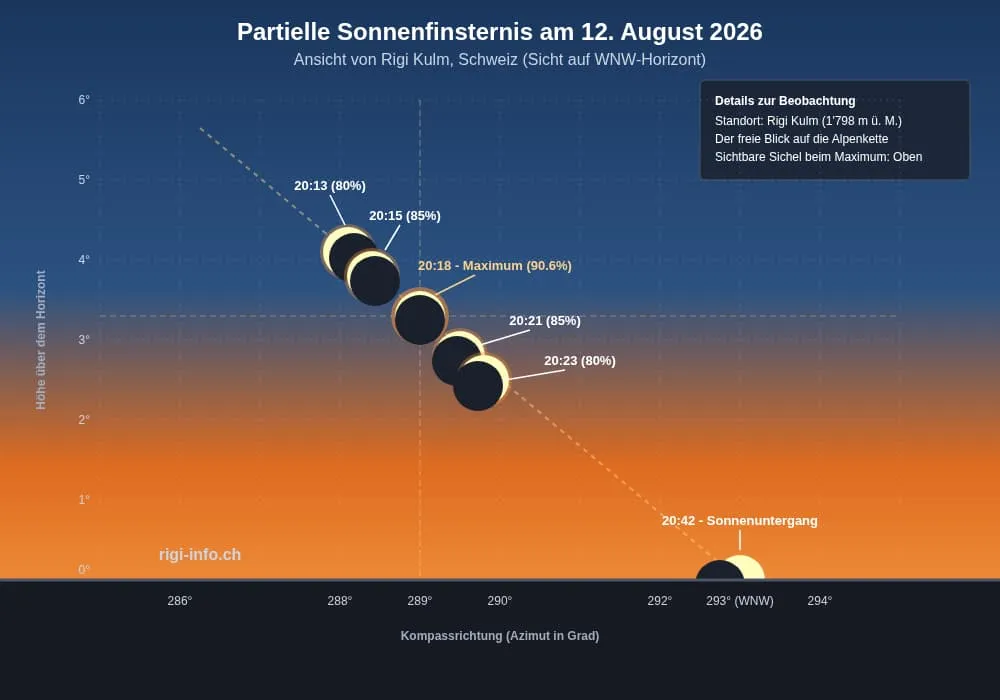
(Graphic)
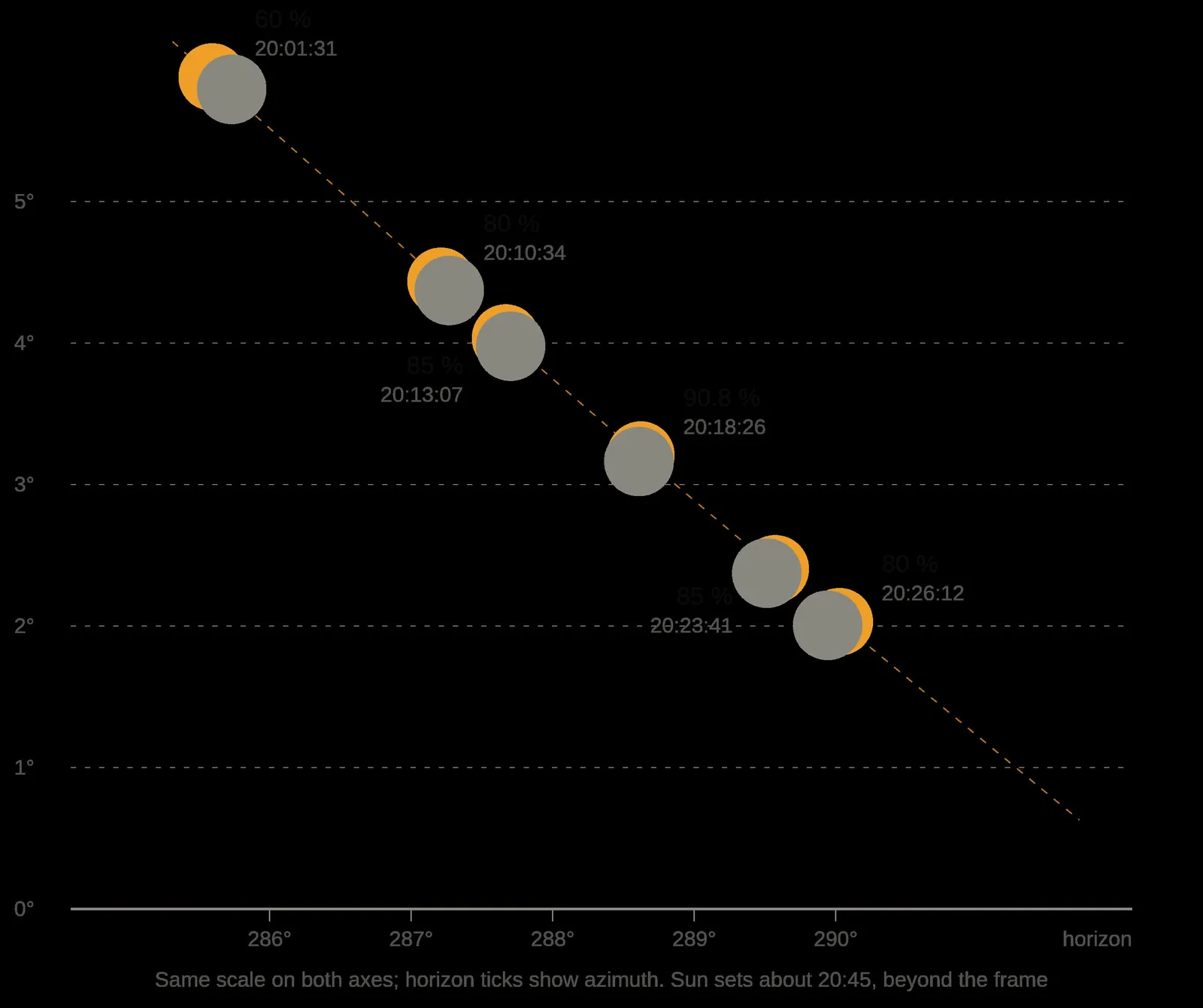
- 80% coverage from 20:10 (Lasts approx. 15 minutes / Altitude 4.6 degrees)
- 85% coverage from 20:12 (Lasts approx. 10 minutes / Altitude 4.2 degrees)
- 91% coverage (Maximum) at 20:18 (Direction 289 degrees / Altitude 3.3 degrees)
- 85% coverage until 20:23
- 80% coverage until 20:25
- Sunset approx. at 20:42 (Direction 293 degrees)
(Graphic)
The solar eclipse on the Rigi
At 1400 to 1800 meters, the geometric horizon shifts downwards. The sun is visible on the Rigi 1-2 minutes longer than the calculated sunset. In addition, there is astronomical refraction: air layers near the horizon optically lift the sun's disk, it appears as a flat "egg" and sets up to two minutes later.
Secondly, there is the haze layer. In August, there is often haze over the Mittelland, which means a very long stretch of air when the sun is three degrees high. At 1400 meters, you are usually above it.
Glasses are necessary despite sunset
It won't feel like night as with a total eclipse, too much will remain. However, the residual sun remains dangerously bright.
The Federal Office of Public Health recommends certified protective glasses; sunglasses are not sufficient. For binoculars, telescopes, and cameras, filters are needed in front of the lens, as these devices additionally concentrate the light.
At Rigi Scheidegg, according to Rigi Bahnen, glasses will be sold for five francs via TWINT in front of the mountain station from 18:30, in limited numbers.
| Time (CEST) | Alt. | Covered | Brightness | vs. Midday Sun |
|---|---|---|---|---|
| 20:10 | 4.6° | 80 % | ~3.4×10⁷ cd/m² | 1/38 |
| 20:17 (max) | 3.3° | 90.5 % | ~1.1×10⁷ cd/m² | 1/120 |
| 20:25 | 2.2° | 80 % | ~1.7×10⁶ cd/m² | 1/770 |
| 20:33 | 1.1° | 63 % | ~6×10⁴ cd/m² | 1/25 000 |
At maximum, the sun is still approx. 10× brighter than the sunset sun. And, since the surroundings are darker, your pupils are correspondingly wide, and the blink reflex, which normally prevents you from looking directly into the sun, no longer works. This can quickly lead to retinal damage.
What also works without glasses: From about 60 to 70 percent coverage (after approx. 20:00), the light spots under trees become crescent-shaped, because every gap in the foliage acts like a pinhole camera. A kitchen sieve is sufficient in an emergency and can be worn as a head covering afterwards.
What will the 2026 solar eclipse look like?
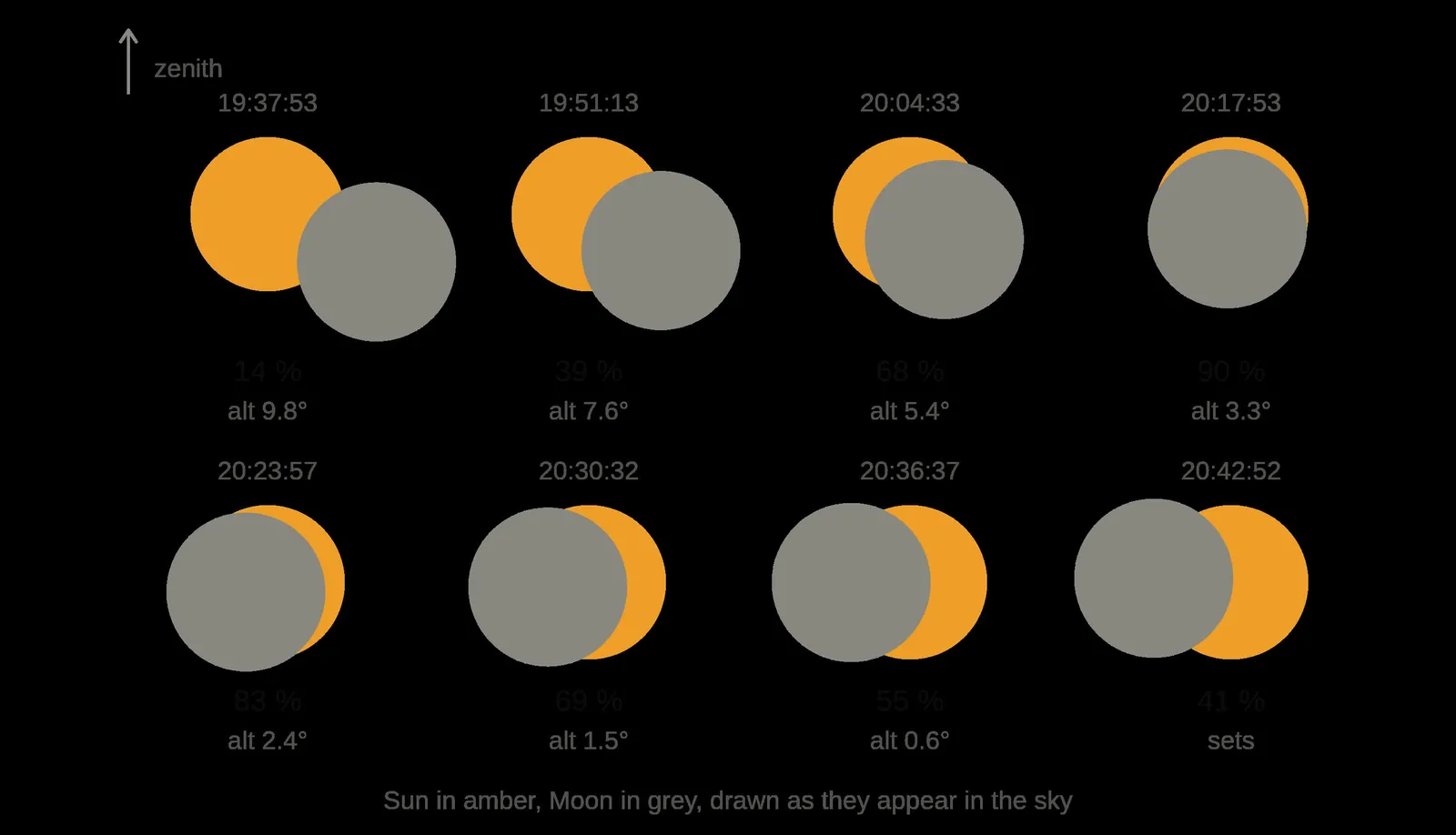
The sun will be low in the west-northwest (WNW). According to my own calculations, at maximum, the remaining bright crescent will be a thin, almost horizontal arc at the upper edge of the disk, with the black moon filling everything below. Until sunset, the image will rotate by about a quarter turn: the dark "bite" will then be on the left, leaving a shape curved to the right. There will be no "devil's horns" (two crescent tips protruding from the horizon). The Astronomical Society of Lucerne has an animation of the process.
(Graphic)
Suitable locations on the Rigi
Känzeli. The Känzeli viewing platform is about a 15-minute walk from Rigi Kaltbad, the path rises slightly and is easily manageable with a stroller. On site there are seating areas, a telescope, and a (closed - due to fire hazard) barbecue area. The view extends over Lake Lucerne and the Lucerne region to the Mittelland, with an open western and northwestern view. The platform itself is small; it will be crowded during this event. (Google Maps)
Felsenweg near Rigi First. On the Felsenweg near Rigi First, you can just see the solar eclipse. However, you will miss the sunset. (The Felsenweg is not suitable for people with a fear of heights.) (Google Maps)
Staffelhöhe and Staffel. Between Känzeli and Rigi Staffelhöhe, a path runs along the slope, and practically everywhere along this route you will find spots with an unobstructed view to the west-northwest. Further to Rigi Staffel, the path accompanies the railway line; this section is also suitable. (Google Maps & Google Maps)
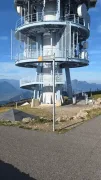
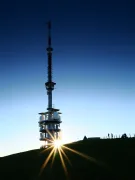
Rigi Kulm. At 1798 meters, the highest point, and certainly with the most visitors. On the way up from Staffel, there are several places where you can step to the fence on the ridge and stand for yourself. (The antenna tower is open in the wrong direction.) (Google Maps)
Rigi Scheidegg. The mountain station of the cable car from Kräbel is at a good 1650 meters. The area near the hiking trail offers an unobstructed view. The Rigi Bahnen write: The Alpenkiosk will remain open longer, glasses will be sold (while supplies last), and there will be extra rides. (Google Maps)
Dossen. On the Dossen, you have a good view of the solar eclipse, but there is not much space there, and the path there can be difficult. Take a flashlight for the descent. (Google Maps)
For the late afternoon, it's worth taking a look at the Rigi Bahnen webcams. Summer cumulus clouds in the west are a risk, and you'll see a cloud bank over the Mittelland on the camera earlier than in any forecast.
Rigi Bahnen solar eclipse timetable
August 12, 2026, is a Wednesday, and the Rigi Bahnen evening timetable is sparse on weekdays :-/. Perhaps there will be unannounced special trips?
Cable car from Weggis: The Weggis - Rigi Kaltbad cable car makes its last descent on Wednesdays at 19:25. That's one minute after the eclipse begins. It's not an option for the return journey.
Cogwheel railway from Vitznau: On the Vitznau - Rigi Kulm cogwheel railway, the last regular uphill train departs from Vitznau at 19:15, arriving at Rigi Kaltbad-First at 19:35 and Rigi Kulm at 19:47. There is also a train departing at 18:15. Downhill from Rigi Kulm, the next train is not until 22:40. In addition, there is an extra train: According to Rigi Bahnen, a train will depart from Rigi Kulm to Vitznau at 0:00 and stop at all official stations.
Cogwheel railway from Goldau: The Goldau side is not a return option on a Wednesday evening. The last regular downhill train from Rigi Kulm to Arth-Goldau departs at 17:48; the later connection only runs from Friday to Sunday.
Scheidegg cable car: From Kräbel and from Rigi Scheidegg, services run at 18:35, 19:05, 19:35, 20:05, 20:35, and 21:05. From 20:35 onwards, services run continuously depending on passenger numbers, and at Kräbel there is a connection to Goldau at 21:35.
Check the timetable before departure!
On foot: The walk down to the valley takes approx. 1.5-2.5 hours, depending on the route. The path is unlit, often goes through the forest, and - depending on the route - involves ladders. Not suitable for the inexperienced.
Determine exact sun position
On SunCalc, zoom in on the Rigi, set the location marker, and select "Partial Solar Eclipse" at the top. The thick yellow beam shows the direction to the eclipsed sun, the red one to sunset. You have to estimate yourself whether a mountain is in the way.
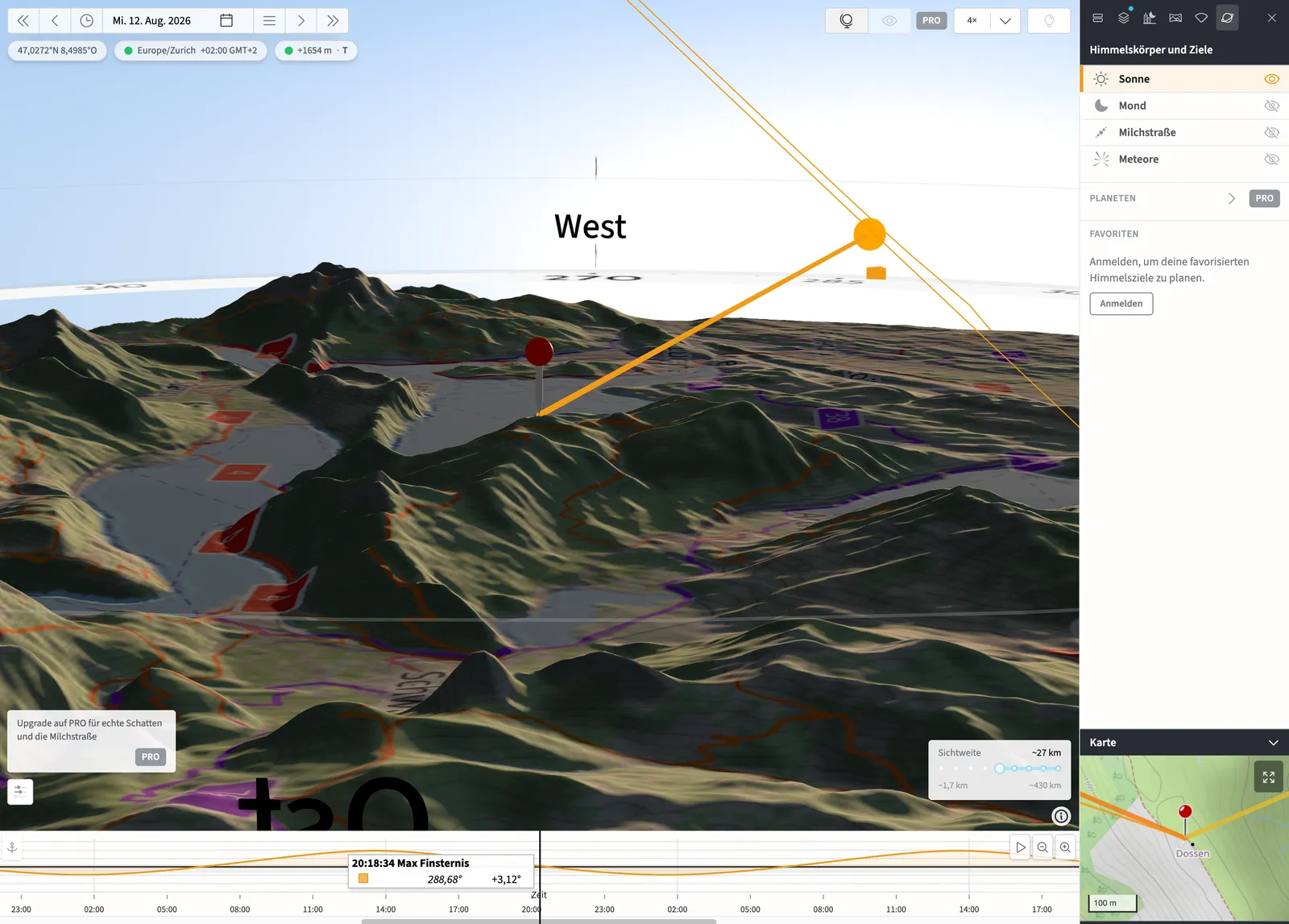
The Photo Ephemeris can do more. Set the location, set the date to August 12, select "Max Eclipse" on the right. The 3D mode is useful: set the visibility range at the bottom right to about 27 kilometers, then the Pilatus will appear in the picture and you will see what is actually in the way. A login window appears regularly but can be closed; the basic functions are free.
The Perseids after sunset
August 12 is at the maximum of the Perseids, and the Astronomical Society of Lucerne explicitly recommends turning your gaze from northwest to northeast after sunset. Those who take the extra train at 0:00 from Rigi Kulm will have a good three hours of dark sky at 1800 meters in between.
The Perseids return every year, approximately between July and August. If you miss them this year, you can easily see them another time.
Some location analyses
Staffelhöhe
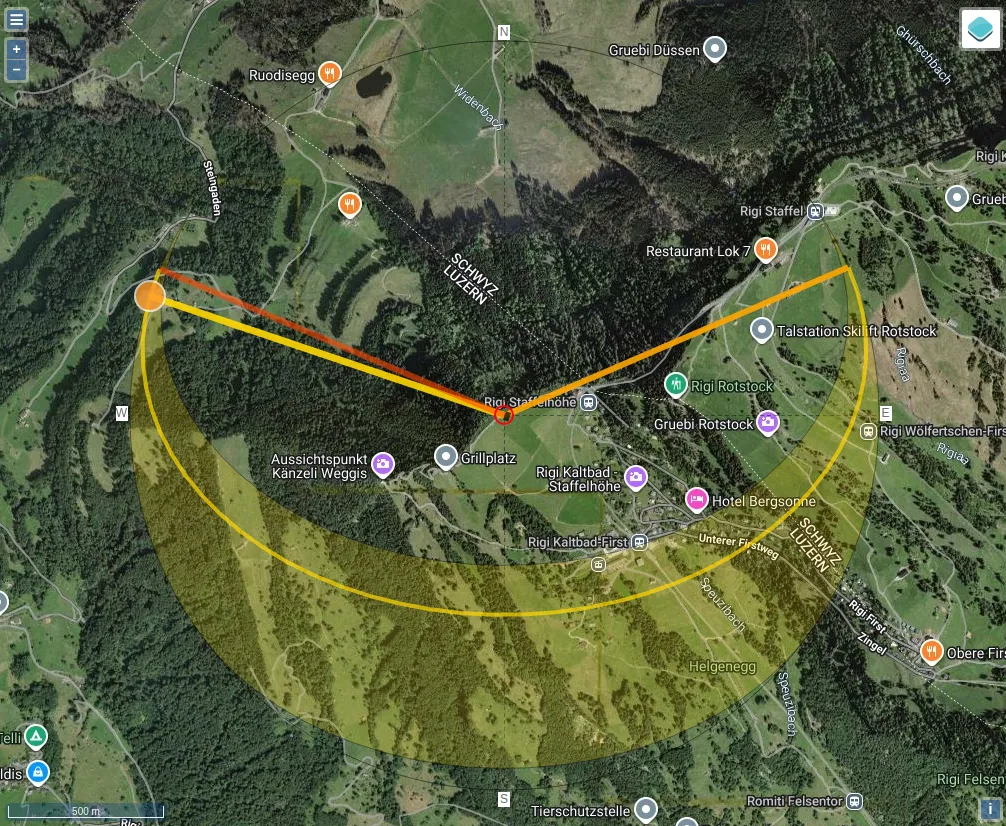
Yellow beam indicates the solar eclipse
Scheidegg
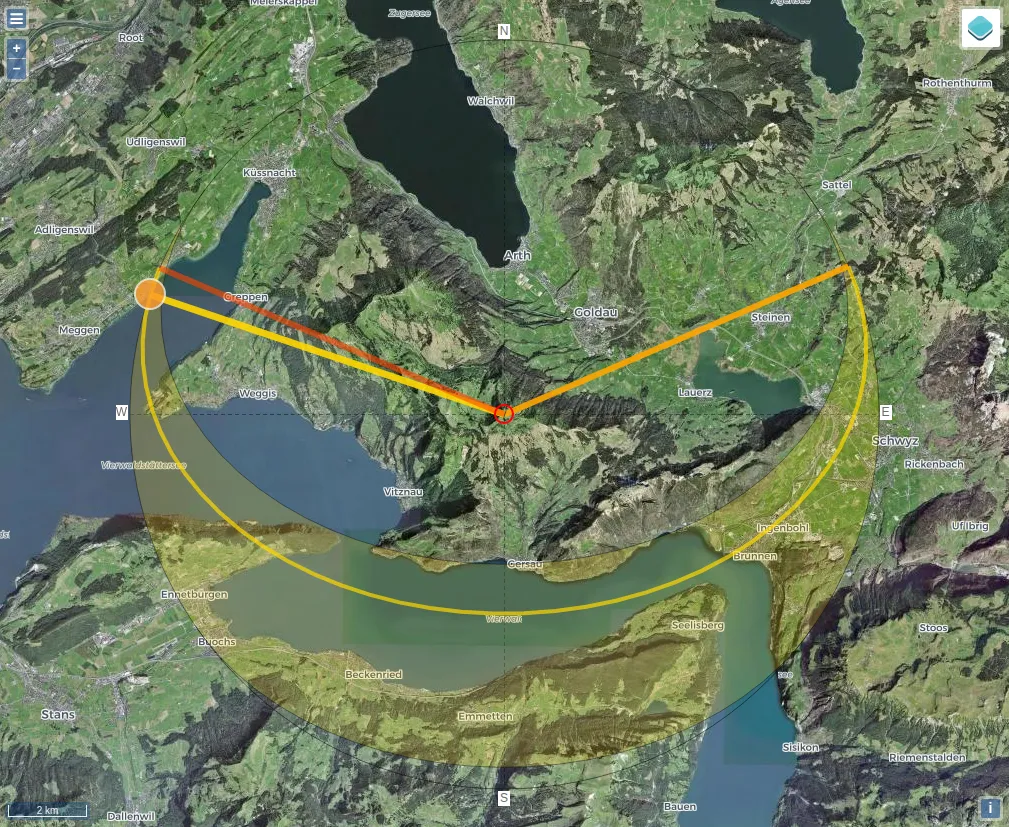
Yellow beam indicates the solar eclipse
Rigi Kulm
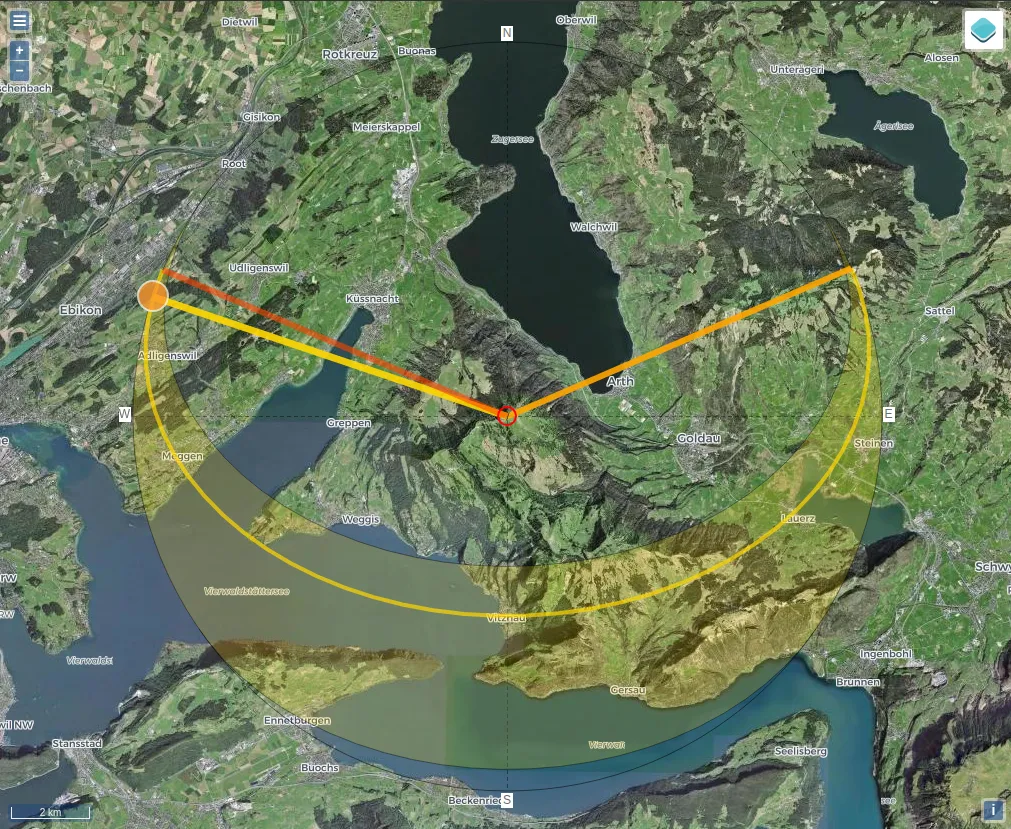
Yellow beam indicates the solar eclipse
Känzeli
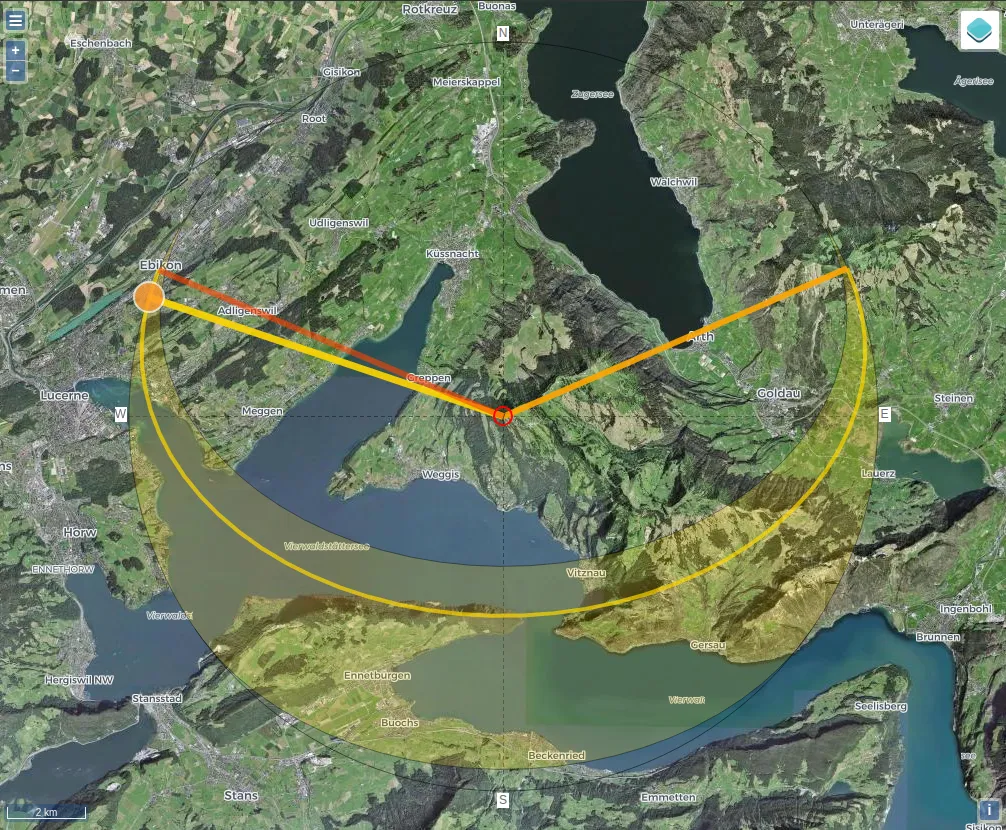
Yellow beam indicates the solar eclipse
Felsenweg near Rigi First
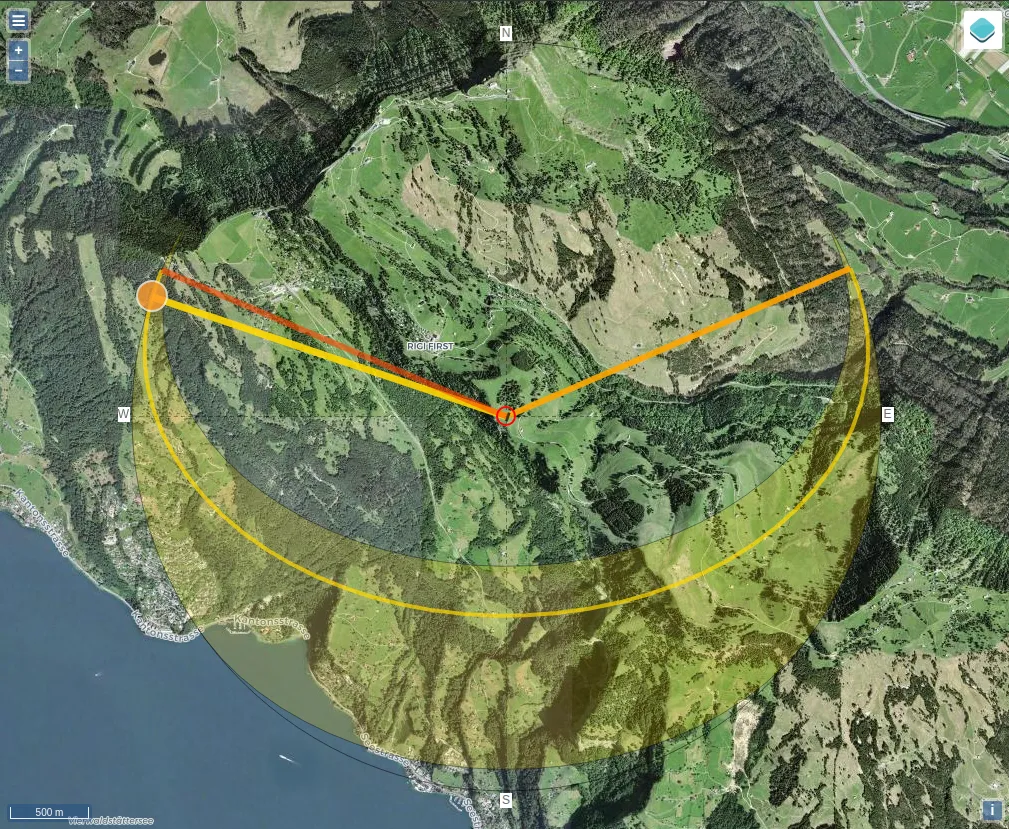
Yellow beam indicates the solar eclipse
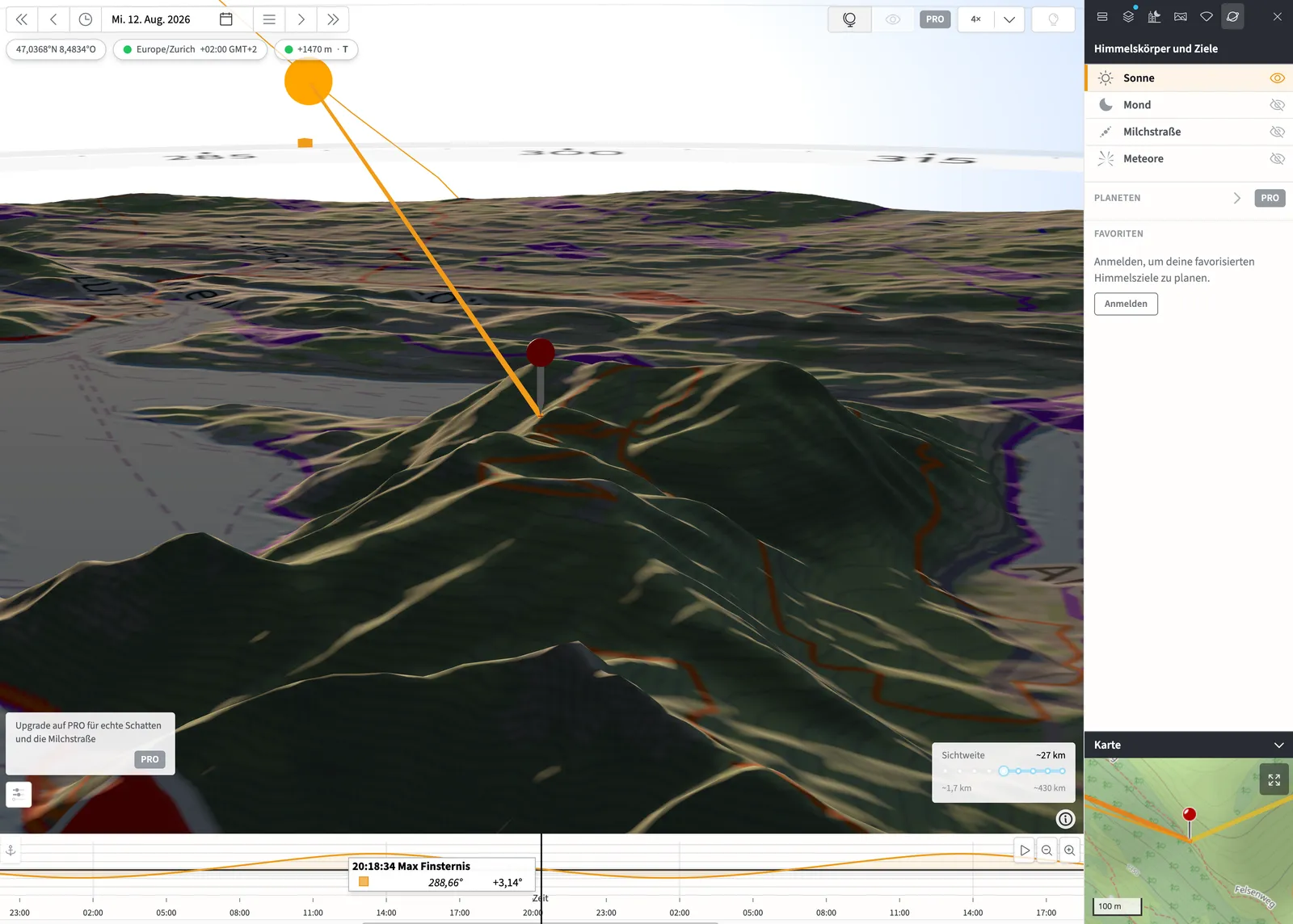
Dossen
More sources
- https://en.wikipedia.org/wiki/Solar_eclipse_of_August_12,_2026
- https://sag-sas.ch/sonnenfinsternis-20260812/
- https://www.20min.ch/story/sonnenfinsternis-2026-die-wichtigsten-infos-fuer-die-schweiz-103607284
- https://sternwarteluzern.ch/die-totale-sonnenfinsternis-vom-12-august-2026/
- https://www.rigi.ch/event/partielle-sonnenfinsternis-auf-der-rigi-46378280f7
- https://www.bag.admin.ch/de/sonnenfinsternis-12-08-2026
- https://www.switzerland-highlights.com/de/rigi-kaenzeli-panoramablick/
- https://www.verkehrshaus.ch/de/landingpages/sonnenfinsternis-2026
- https://www.timeanddate.com/eclipse/in/switzerland/lucerne?iso=20260812
- https://theskylive.com/solar-eclipse?id=2026-08-12&cc=CH
- https://www.eclipsewise.com/solar/SEprime/2001-2100/SE2026Aug12Tprime.html
- https://www.watson.ch/wissen/leben/399951500-was-du-zur-sonnenfinsternis-in-der-schweiz-im-august-2026-wissen-willst
- https://wetteralarm.ch/blog/sonnenfinsternis.html
- https://enjoymedia.ch/Ratgeber-Wissen/Sonnenfinsternis/
- https://www.radio-luzern.ch/rigi-bahnen-2026-preise-fahrplan-sonnenfinsternis/
- https://ch-events.ch/events/partielle-sonnenfinsternis-spezialabendfahrten-bis-23-00-uhr/
- https://www.luzern.com/de/tour/rigi-kaenzeli-spazierweg