2013, the Rigi was a topic of discussion in the future tense. The second home initiative had been accepted in March 2012, the first partial revision of the Spatial Planning Act passed the popular vote in 2013 with almost 63 percent in favor and, as EspaceSuisse notes in its chronology of the RPG revision, came into force on May 1, 2014. It seemed certain that two such fundamental instruments would also change something on the mountain.
The Rigi Anzeiger wrote at the time that the proportion of second homes on the Rigi was over 80 percent, the building zones were too generously dimensioned, and the new federal regulations would correct this. The article was by Angelo Zoppet; the three statements could not be independently verified, and the original document was not found for this text. Nevertheless, they serve as a touchstone because they formulate a clear expectation: the law takes effect, and it does so where construction takes place.
Thirteen years later, you can recalculate. The result has roughly materialized – but the mechanism is different.
What the law has actually changed
The Federal Act on Second Homes has been in force since January 1, 2016. Its core is a single threshold: if the proportion of second homes in a municipality exceeds 20 percent, no new second homes may generally be approved there. The ban is not absolute – touristically managed apartments remain possible, as do primary residences and apartments treated as such, as the ARE explains in its Second Homes dossier. Apartments that already existed on March 11, 2012, are considered old law and retain their freedom of use.
It was precisely with these old-law apartments that the biggest relaxation to date began. Following a parliamentary initiative by National Councillor Martin Candinas, the Federal Council put the legal amendment into force on October 1, 2024. For the existing stock on the mountain, this is more relevant than any new building permit, because it is the existing stock that shapes the townscapes.
The number of affected municipalities has hardly changed since then. In March 2026, the ARE counted 331 second home municipalities, six fewer than a year earlier, which is mainly due to mergers and cleaned-up register data. From 2027, the federal government will calculate the proportions directly from the federal building and housing register, instead of relying on the municipalities' annual housing inventories. This sounds like administrative technology, but it shifts interpretive power: whoever manages the data basis determines where the threshold lies.
In parallel, the second stage of the RPG revision has arrived. Parliament adopted it on September 29, 2023, and the Federal Council is putting it into force in stages on January 1 and July 1, 2026, as the ARE documents for the RPG 2 revision. Its core is the stabilization target for buildings and sealed surfaces outside building zones, with a margin of two percent per canton, measured against the reference date of September 29, 2023. Also new is a demolition premium equal to the demolition costs – according to EspaceSuisse, a rather weak incentive, because the ARE estimates the costs per demolition at around 20,000 to 30,000 francs, and the federal government only optionally contributes 20 to 30 percent. Tourist-related sealing is excluded from the stabilization target anyway.
If you're wondering what the major revision actually changes on the mountain, the answer is: directly, little. RPG 2 targets areas outside settlements, because construction on Rigi Kaltbad takes place within the building zone. The actual control remains with the Second Homes Act – and with the municipalities.

One village, two cantons, three municipalities
The settlement is spread across two cantons and three municipalities. This is not a curiosity, but the reason why the 20 percent threshold has different effects on the mountain. Weggis and Vitznau are in the canton of Lucerne and exceed it; Weggis was reported with 21.0 percent in 2018, Vitznau with 34.0 percent, as the Luzerner Zeitung reported from the ARE survey. Arth in the canton of Schwyz has not exhausted its share; the canton lists the values of its municipalities in the Schwyz data portal. When comparing, you should be careful: the ARE explicitly points out that the inventories between municipalities cannot be directly compared because the municipalities manage them differently.
The result is a planning line right through the mountain forest. Construction takes place where it is still possible, i.e., on Schwyz territory. In the summary of the ETH event "The Furnished Mountain" from 2022, spatial planner Michael Camenzind showed that in the ten years up to 2022, around 60 new apartments were built on the Rigi, mostly in new holiday homes; some of them tie in with the timber construction tradition that was established here with chalets since the 1920s.
In terms of planning, the two relevant municipalities diverge. On the Schwyz side, building zones are still available, and Arth's municipal master plan assigns the settlement area on the Rigi to the tourism action area. On the Lucerne side, a country house zone with a protective character dominates, combining chalets and the surrounding mountain forest, and the then not yet adopted settlement guideline of Weggis stated that the number of second homes on Rigi Kaltbad should be minimized.
Around eighty people
One figure frames the whole thing: According to the same summary, around 80 people live on Rigi Kaltbad all year round. Everything else can be read as a consequence of this.
The primary school used to exist as long as it was attended by children on Schwyz territory. Today there is again a school, but on a private basis. The post office is closed, a large part of the tourism staff commutes to the mountain. Gregor Vörös, hotelier and president of the Rigi trade association, said at the event that the school could only be permanently secured and transferred to public ownership if substantially more families moved in. There were interested parties for primary residences; there was a lack of apartments, and a concrete project was blocked by objections.
In addition, there are counter-movements that do not require building permit procedures. The EneRigi cooperative aims to produce all the energy consumed on Rigi Kaltbad locally. And Michael Camenzind has been working for years on a co-working space called "Bergwerk" (Mine), intended for digital workers as well as for people who want to dedicate themselves temporarily to artistic work on the mountain. Both aim at the same thing: more presence, less seasonality.
From playing to balance
In April 2016, Rigi Plus AG and Rigi Bahnen AG presented a master plan for Rigi tourism, which included a visitor platform on the transmission tower, a "Swiss mountain village" with a show dairy, and a treehouse world. Criticism of this led to the "No! to Rigi-Disney-World" petition in autumn 2017, as the Luzerner Zeitung describes in its review of the first Rigi conference.
On January 11, 2019, the Rigi 2030 Charter was signed on Rigi Kulm, by, among others, Rigi Bahnen, the municipalities of Weggis and Vitznau, IG Rigi Kaltbad-First, Unterallmeind Korporation Arth, the Vierwaldstättersee Landscape Protection Association, and the Pro Rigi Association. The Charter itself states that it has no legal binding force; it is a self-commitment with a development plan, a review every four years, and an annual Rigi conference. The development plan provides for monitoring with 28 sustainability indicators.
The round was never complete. WWF, Pro Natura, and the Canton of Schwyz's heritage protection withdrew and did not sign; the principles were too vague, SRF reported at the end of November 2018. The Vierwaldstättersee Landscape Protection Association countered that a charter could not contain concrete demands, but only indicate a direction.
The petitioners around René Stettler consider the Charter to have failed. On their argumentation page, they accuse it of formulating intentions instead of standards, not providing for independent monitoring or sanctions, and possessing neither democratic legitimacy nor the enforcement power of a binding regulatory framework; they call it a propaganda tool that cost 24,640 francs. As an alternative, they have presented their own Rigi 2040 Charter with binding CO2 targets.
The number being disputed
The second petition demands an upper limit of 800,000 visitors per year and a departure from the guest mix geared towards Asian package tour groups. In 2025, there were a good 1.02 million guests, an increase of 8 percent, with a turnover of almost 40 million francs and an operating result of 13.5 million.
Rigi Bahnen's counter-position does not argue against the number, but past it. CEO Frédéric Füssenich said in an interview with schweizeraktien.net that turnover had grown more strongly than visitor numbers in the last four years; therefore, it was not necessary to transport more people to develop further. In addition, there are two key figures that the company regularly cites: because GA, Half-Fare Card, and Swiss Travel Pass are fully accepted, around 70 percent of guests travel by public transport, and mass tourism accounts for 7 percent of guests, according to the railways.
Both sides are measuring different things. The petitioners count people and landscape interventions, the railways value creation per guest and mode of arrival.
The cable car case
The aerial tramway from Weggis to Rigi Kaltbad dates from 1968. Its concession and operating license were last extended by the Federal Office of Transport for five years until September 2027, as Rigi Bahnen states on its project page for the renewal of the cable car. After that, a solution is needed, and the railways want a gondola circulating ropeway with 22 cabins.

In November 2022, the voters of Weggis approved the cable car corridor and the zoning plan adjustment with 77 percent in favor. The Federal Commission for Nature and Homeland Protection had submitted its expert opinion in 2019 and confirmed it in 2024; it classifies the project as a slight additional impairment of BLN object 1606, i.e., an intervention that does not question the protection goals.
The legal process went differently. In May 2025, the Lucerne Cantonal Court overturned the approval decision of the Government Council from February 2024: when defining the corridor, an opinion from the responsible clearing authority should have been obtained, because the corridor affects forest. In all other respects, the court found the complaints unfounded, reported htr hotelrevue. On March 4, 2026, the Government Council approved the corridor a second time, after the clearing authority had stated that the project was fundamentally compatible with the forest law; the opening is planned for summer 2028.
Regarding the disputed issue of masts, the information only seemingly contradicts itself. Rigi Bahnen speaks of 13 supports at 11 locations, two of which are lattice supports; the petitioners count 11 masts in their older documents and 13 in the 2023 visualizations. The height is undisputed: the support on the Müseralp is, according to critics, around 80 meters high including the concrete base, while the existing concrete mast of the aerial tramway at the same terrain edge measures 44.50 meters. The railways, on the other hand, maintain that the current forest aisle will be maintained and not widened, and the transport capacity will increase from 650 to 850 people per hour – the previously communicated expansion to 1200 will be abandoned.
What worked without dispute
You can find the counter-example on the other side of the mountain. The Kräbel–Rigi Scheidegg aerial cableway was completely rebuilt in 2017 and went into operation in December; SRF cited costs of 6.4 million francs for two cabins for 15 people each. The figures vary: during the public consultation in 2016, around eight million francs were mentioned, and the same consultation stated that the alignment would shift slightly – so the railway did not follow the old axis exactly. Nevertheless, there was no flood of complaints. The difference to Weggis lies less in the structure than in the protected status of the landscape and its visibility from the lake.
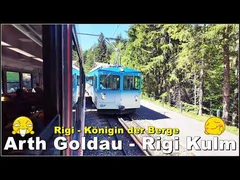
The rest is similarly unspectacular. Four new articulated railcars are planned for the route from Goldau from 2030, estimated at around 22 million francs. The Kräbel station is currently being rebuilt and made barrier-free; the Luzerner Zeitung mentions 1.5 million francs, the Bote der Urschweiz around 1.2 million. In 2027, track renovations will follow at Klösterli and Staffel. And the small infrastructure is growing with it: Rigi Bahnen currently lists 16 fire pits and picnic areas. How many there were before could not be verified.
What the forecast got right – and what it didn't
In terms of outcome, those who expected a correction in 2013 were right. On the Lucerne side, practically no new second homes are approved anymore, and the discussion revolves around existing stock rather than expansion. In terms of mechanism, the forecast was wrong. The Second Homes Act did not stop new construction, but shifted it – to Schwyz territory, where the threshold has not been reached. And the most effective brake recently was not the building authority, but the court: a single procedural defect in obtaining an opinion set the cable car project back by about two years. If you want to prevent or delay something today, you no longer argue with utilization figures, but with procedural law.
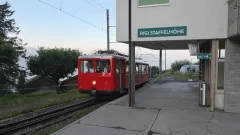
The line where this is decided is old. When the cogwheel railway was opened from Vitznau in 1871, it initially ended at Staffelhöhe, as espazium noted for its 150th anniversary – there the cantonal border between Lucerne and Schwyz ran, and the extension to the summit was the business of an Arth company. One hundred and fifty years later, this border is still the sharpest planning line on the mountain. It separates not two landscapes, but two legal situations.