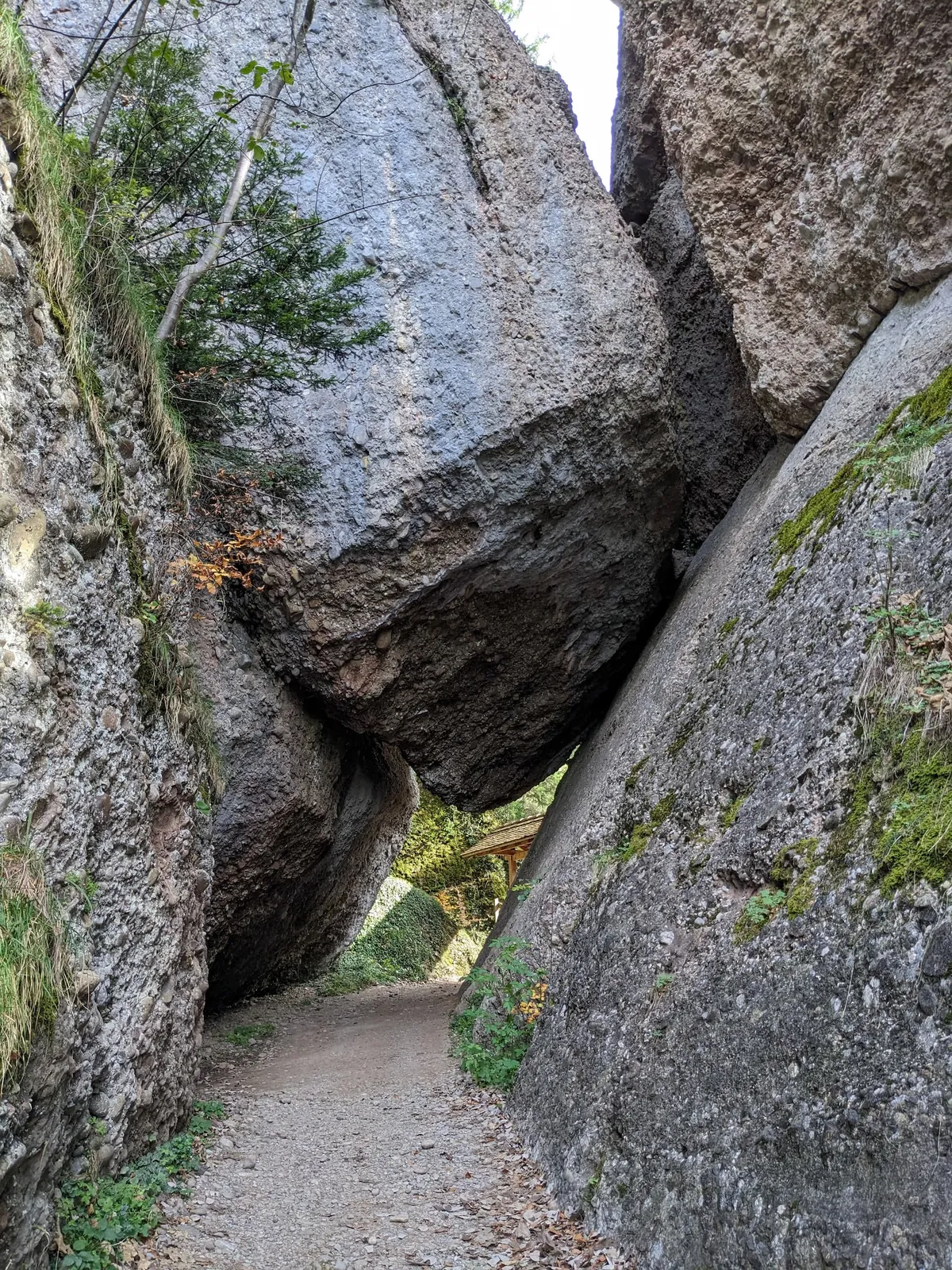
Between Vitznau and Rigi Kulm, there is a stop where most people remain seated. Romiti-Felsentor is a request stop, and those who alight here usually go downhill, not uphill. After a few minutes, three boulders wedged against each other block the path – until one realizes they form a passage. This is the eponymous Felsentor (Rock Gate). Immediately behind it stands a house built about 150 years ago for a form of transport that ceased to exist less than three years later, and next to it, a meditation hall in Japanese style. Both belong to the Felsentor Foundation.
An Inn for a Form of Transport That Disappeared
Before the cogwheel railway arrived, Rigi could be reached on foot, by horse, or in a sedan chair. According to the Felsentor Foundation's account of local history, the path from Weggis via the Heiligkreuz Chapel to Kaltbad was the most frequented of these routes. At Hochstein, as the rock is also called, what a transport hub needed back then was first built: an inn for porters, guides, and guests, as well as a watering trough for horses and mules. The foundation states that the place name Romiti traditionally refers to "rest in the middle"; an independent onomastic confirmation for this could not be found.
The inn became a hotel. Sources differ on its year of construction. The foundation names 1869 as the opening year and describes an astonishingly complete operation: 30 beds, dining room and ladies' salon, a first and second-class café, an annex with staff rooms, and a horse stable. The building documentation "Kuppel – Tempel – Minarett" by the Center for Religious Studies at the University of Lucerne dates the construction to "around 1860" and names the municipality of Weggis as the builder.
The hotel's business model was based on a simple assumption: those ascending on foot or with animals needed a break halfway, an overnight stay, and fodder for the horses. This assumption became obsolete on May 21, 1871. On this day, according to the railway chronicle of Rigi Bahnen AG, the Vitznau-Rigi Railway, Europe's first mountain railway, was inaugurated up to Rigi Staffelhöhe, followed by the section to the summit station on June 23, 1873. Travel time shrank to a good half hour, and with it, the reason for an overnight stay en route disappeared. The halfway location, until then the entire business model, became a locational disadvantage.
What followed reads like the history of many functional buildings whose purpose has ceased: sale in 1929, use as a children's home in the 1940s and 1950s, followed by several years of vacancy. In 1966, Claudine and Josef Hofmann-Siegrist acquired the property, and from 1983, it was temporarily open as a mountain restaurant – from July to September, on weekends and holidays.
Planned Access via Car Road
In 1930, a plan emerged to build a car road to Rigi. This would have also passed through Felsentor. The road was never built.
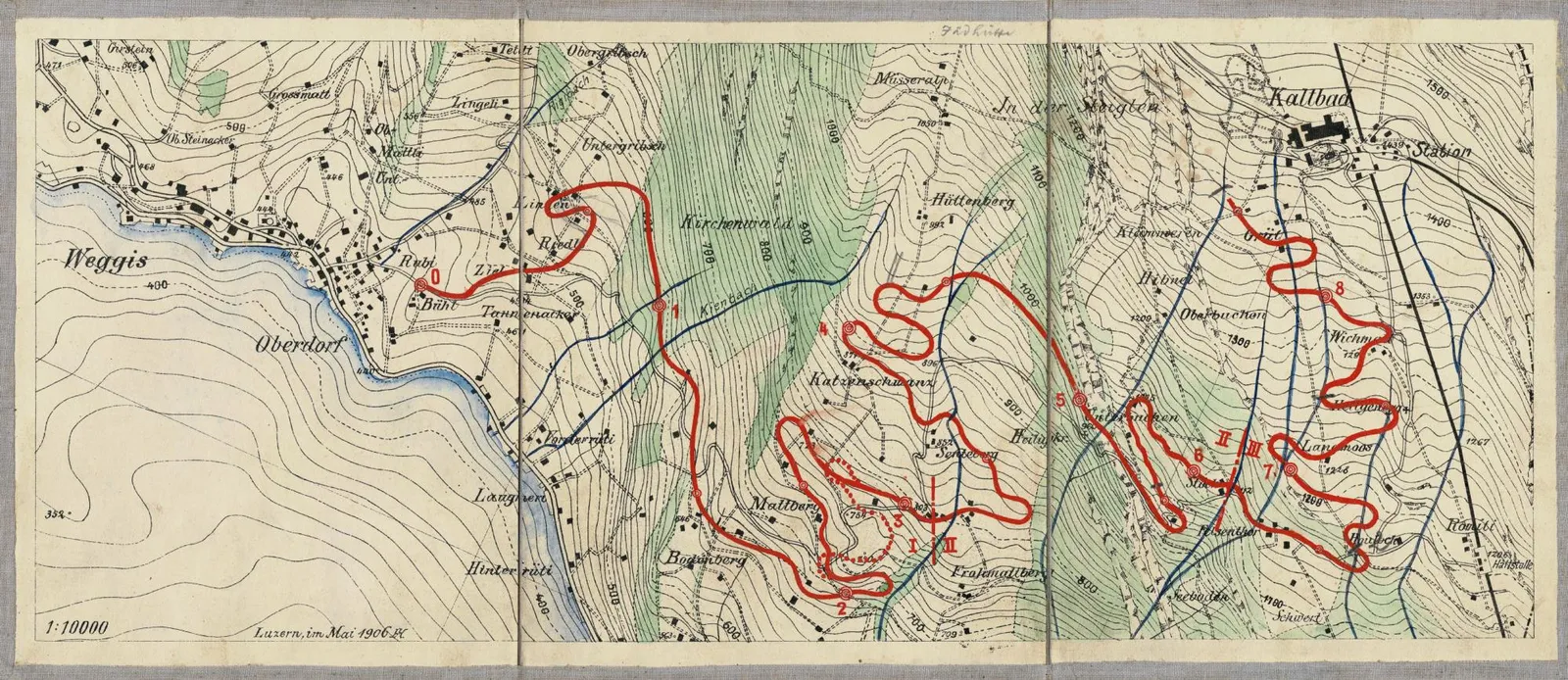
Planned car road from Weggis to Kaltbad Source
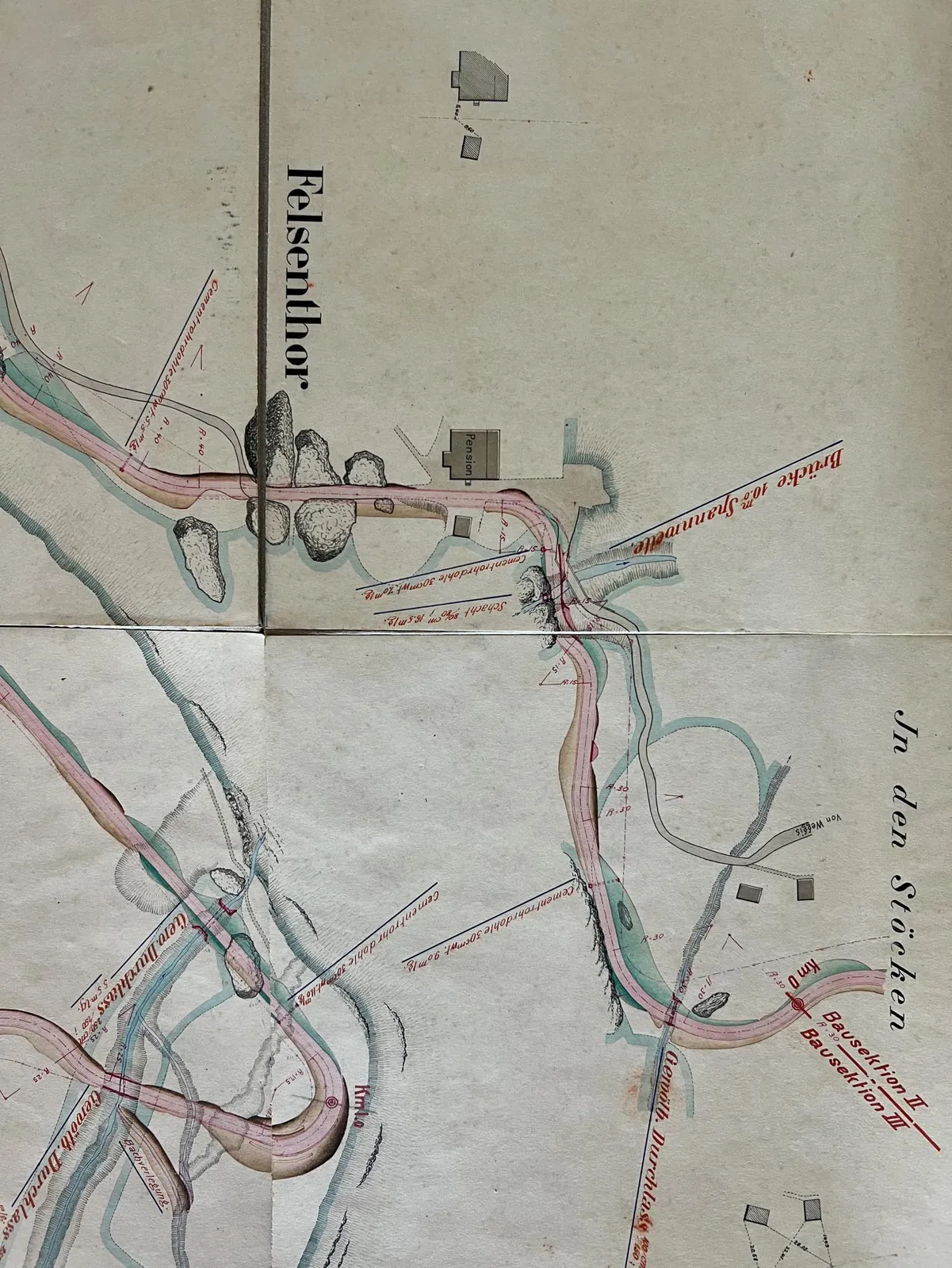
Passage in Felsentor from Source
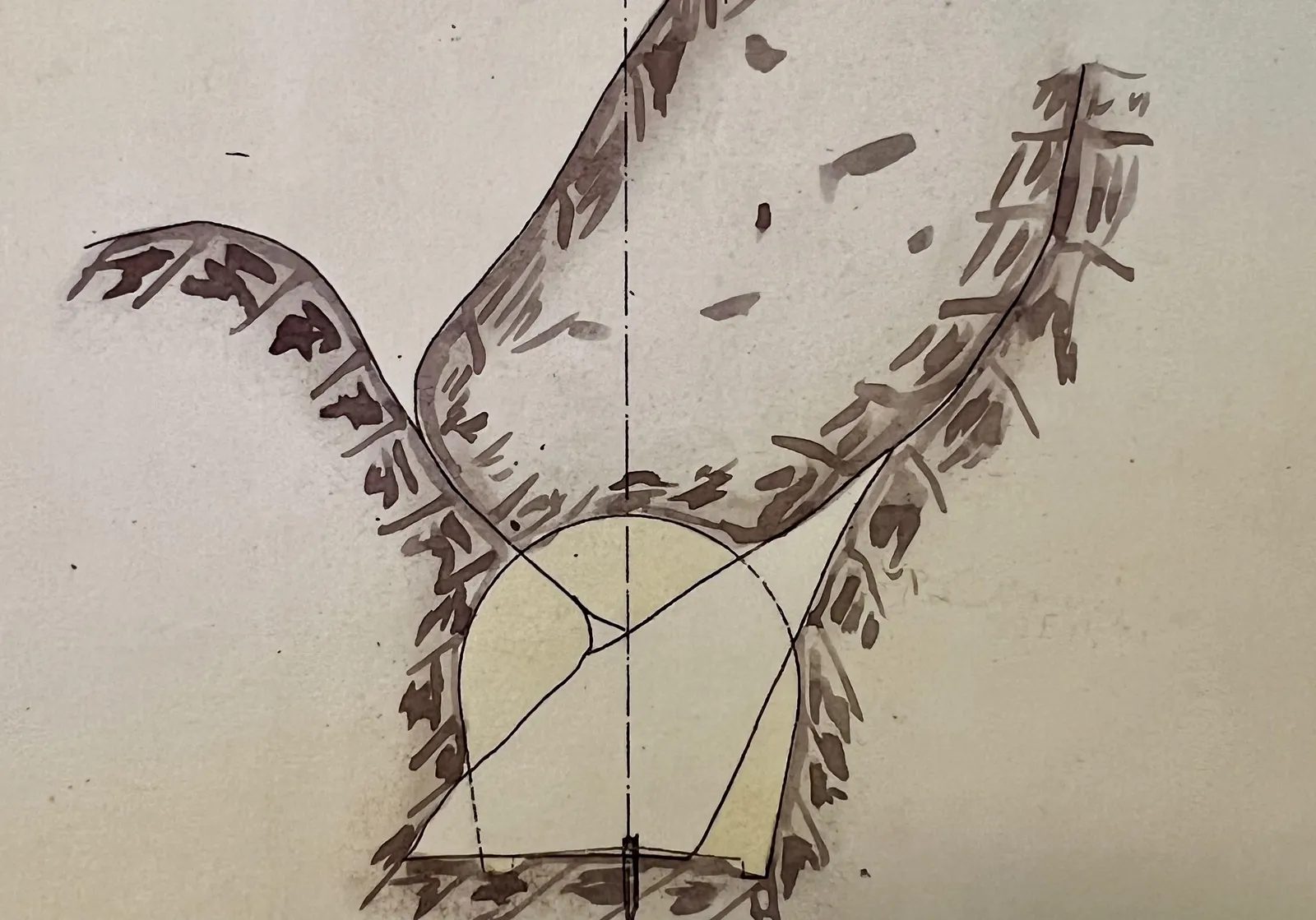
Planned passage in Felsentor from Source
How the Romiti Hotel Became a Zen Center
The second idea for use came from outside. Vanja Palmers, according to his portrait on the foundation's website, born in Vienna in 1948 and brought to Switzerland as a toddler, broke with his predetermined career path after studying economics in Zurich, came to Zen Buddhism in 1972, and spent ten years at the Tassajara Zen Monastery in California, where he was trained as a priest. There he met the two men who became his teachers and friends: Zen Master Kobun Chino Otogawa Roshi and Benedictine monk David Steindl-Rast. With the latter, he founded the "Haus der Stille" Puregg in Dienten am Hochkönig, Austria, in 1989. The NZZ noted in a 2017 portrait that Palmers comes from an industrialist family and had an inheritance; it attributes him to the Palmers textile dynasty and names Felsentor as one of the projects he made possible.
The reason for the purchase was practical. Palmers explained to the Lucerne research project that there were hardly any secluded zendos in Switzerland where one could also stay overnight and hold multi-day sesshins. An empty hotel with a view, no car access, and a railway connection offered exactly that. In 1999, the newly founded Felsentor Foundation acquired the property; Steindl-Rast appears as a co-founder. Most accounts, including the brief information from the Religious Studies Seminar at the University of Lucerne and the relinfo.ch lexicon on Zen organizations in Switzerland, name 1999 as the founding year; the foundation database Fundraiso, however, lists 2000 as the founding year.
What the foundation is supposed to do is stated in its published statutes. It is a non-profit foundation according to Art. 80 ff. ZGB with its seat in Weggis, and the purpose article lists four points: to improve the relationship of humans to themselves and their environment, to create a place of silence, to acquire and maintain the Felsentor property – plot no. 550, land register Weggis – and to overcome the idea that human well-being is fundamentally more important than that of other sentient beings. The foundation board works on a voluntary basis; Steindl-Rast and Palmers are lifelong members as founders. The dissolution clause is noteworthy: if assets remained after all debts were paid, they would go half to animal welfare and half to a meditative purpose.
Seminar operations have been running since 2002. The foundation is registered in the commercial register under number CHE-109.550.313, and its domicile was moved to Rigiweg 27 in 6356 Rigi Kaltbad in 2019, as shown by the register extract at Moneyhouse.
The Zendo: A Building That Should Not Be Categorized
The most striking part of the complex is the newest. The Lucerne building documentation lists the hard facts: 145.5 square meters of floor space, 8.10 meters building height, groundbreaking in July 2003, 14 months construction time, inauguration on September 22, 2004. The architect was Paul Discoe from California, an American Zen priest who studied temple building in Japan. Palmers describes his intention as follows: a building should be created that "cannot be clearly assigned either temporally or culturally."
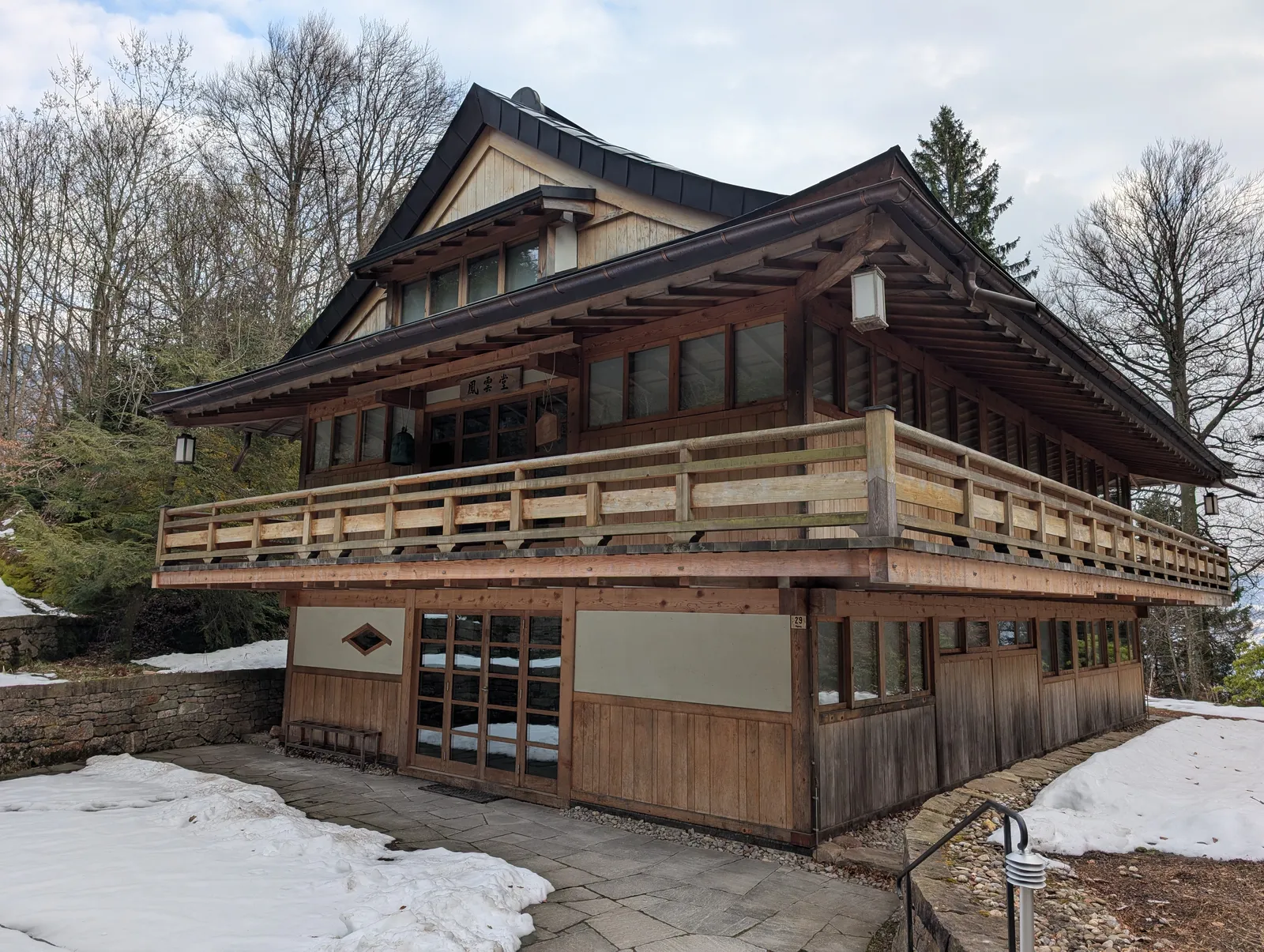
That the construction was approved at all is less self-evident than it appears from the outside. Three hurdles lay on top of each other. First, the claimed land was outside the building zone. Second, Rigi is listed in the Federal Inventory of Landscapes and Natural Monuments of National Importance, specifically in BLN object 1606 "Lake Lucerne with Kernwald, Bürgenstock and Rigi", whose sub-area 3 includes Rigi. Third, the expected appearance of the Zendo was an issue for the authorities themselves. The mechanics behind this are legal: as the overview of BLN areas by artenschutz.ch states, the construction of buildings outside the building zone in a BLN object is a federal task, requiring an expert opinion from the Federal Commission for Nature and Heritage Protection. Thus, an extension next to an old hotel becomes a multi-stage procedure. In the Lucerne documentation, the objections are noted as internal administrative and with the keyword forest distance; after lengthy negotiations, the building permit was granted.
Animals as Part of the Felsentor Community
Animal welfare is not a side program at Felsentor but is enshrined in its purpose article. According to the list of animal sanctuaries by ProTier, the animal welfare center has existed since 2005 and primarily takes in former farm animals. It was built up by Sister Theresia Raberger, a Franciscan nun and Zen priest. In an interview with Buddhismus Aktuell, she describes the beginning: she came to Rigi in September 2005, and in October, the first animal arrived, an abandoned boar named Francis. Others came after confiscations or on the advice of other animal welfare activists.
The most famous case was an ox named Nandi. The magazine Vegi-Info reported on his rescue in 2005: Ten months old, he was to be killed in the Baar slaughterhouse, jumped through a glass pane, lived in the forest for a while, and after his recapture, was bought by Palmers, who paid more than the usual slaughter price. The case exemplifies how the foundation understands its purpose: not as comprehensive rescue, but as a visible individual case with public impact.
The Felsentor Foundation's Operations Today
Those who inquire today no longer reach the founders. The foundation's contact page names Anette MyōZen Nüscheler as director and Jessica Antusch for the animal welfare center. The information on the size of the house community contradicts itself, which is not surprising for a place with changing residents: the Lucerne brief information speaks of seven people, the building documentation of about ten, relinfo.ch of eight to twelve permanent residents.
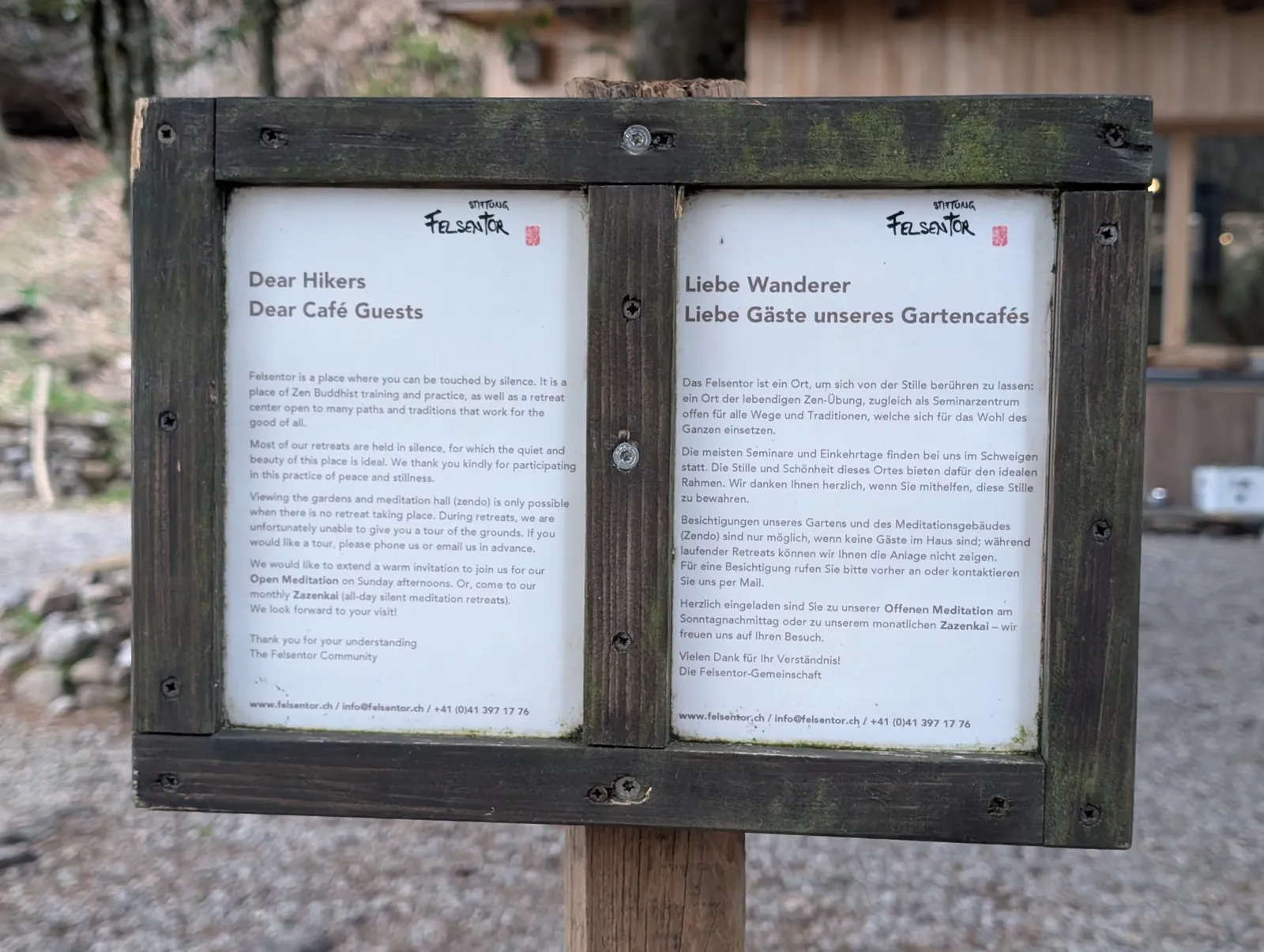
What is most visible to the outside is the garden café. It operates on a self-service basis and, as the description on rigi.ch notes, is open to hikers; otherwise, the house is only available for courses and individual retreats. The same page mentions an open meditation every Sunday at 5 p.m. with a subsequent tea round. Earlier information, for example in the directory Schweiz in der Stille, mentions 6 p.m. in summer and 5 p.m. in winter and Sister Theresia or Palmers as leaders – an indication that times and responsibilities have shifted over the years.
The foundation has since expanded its terrain. The Obere Frohmatte and Sentiberg properties are about half an hour's walk below Felsentor and are not publicly accessible; a new Zendo there is open on Wednesday evenings for open meditation, opposite the farmhouse at Rigistrasse 240 in Weggis. The organic farm Frohmatte, about 300 meters lower in altitude, supplies food for the course operations. In the city of Lucerne, the circle around Palmers also operates the Zendo am Fluss, opened in 2018, with a vegan restaurant.
The prices are understandable for a seminar house of this size: a Sesshin announcement from 2023 shows full board at 95 francs per day in a multi-bed room, 130 in a double, and 160 in a single room, plus tourist tax and a freely chosen Dana contribution for the teacher. Current rates may differ.
A date from the current year concerns the co-founder: David Steindl-Rast turned one hundred years old on July 12, 2026. He lives in the Europakloster Gut Aich near St. Gilgen, as the report by the Catholic News Agency on the anniversary notes.
Silence on a Mountain with Almost a Million Guests
Felsentor is not in seclusion, but at its edge. Rigi Bahnen counted 910,000 first entries in 2023, according to data from the trade journal htr hotelrevue, an increase of 12.6 percent. For 2024, the CFO at the general meeting reported around 940,000 guests, according to schweizeraktien.net, making it the second-highest visitor volume in history. How Rigi is to develop has been the subject of a formalized process since the "Charta Rigi 2030" of January 11, 2019.
Palmers described the relationship with the municipality, authorities, and passing hikers as consistently good to the Lucerne research project – an assessment by the foundation president, not a neutral finding. More remarkable is the reversal he describes elsewhere: the relative seclusion with good railway connections has turned from a disadvantage into an advantage. Exactly the location that ruined the hotel in 1871 makes the place usable today. A request stop is a good address if you want most people to continue their journey.
Practically, this means: from Romiti-Felsentor station, it's about 15 minutes according to Zen-Verein imakoko; from Weggis, an old footpath leads up in one and a half to two hours. The station is at about 1200 meters.